|
|
 |
|
|
The US Army in The Pacific
 |
The US Army in The Pacific
By Adam Brooker
While the US Pacific campaign may be seen primarily as a fight involving mostly the US Marines and the US Navy in their island-hopping campaign, the US Army was also heavily involved in some of the very first battles between the United States and Japan, as well as some of the toughest campaigns of the Pacific. Without the logistics and supply expertise that the US Army brought with them, it would have been a much tougher fight, and their fighting contribution was also important when initial US Navy Forces were stretched thin.
|
|
In the previous Pacific theatre book - Gung Ho, the only Allied option was the US Marine Forces, but with the release of The Pacific, 1942 - 1943 this now allows you to field US Army forces as well as British and Commonwealth Allies. The US Army in the Pacific carries over two Formations from the desert Mid War Fighting First book, the Rifle Company and the M3 Stuart Tank Company. These are still the familiar Formations you have come to know from the, but with some new support options.
Here are the Formation Diagrams of the Rifle Company and the M3 Stuart Tank Company. As you can see there is no change, the Rifle Company is a large Formation with a lot of support weapons.
|
|

|
|

|
|

|
|
M3 Stuart Tank Platoon
Let's talk briefly about the M3 Stuart Tank Company, it is a more versatile force with support options, when compared to the US Marine Stuart Formation which only has the option of M3 Stuarts.
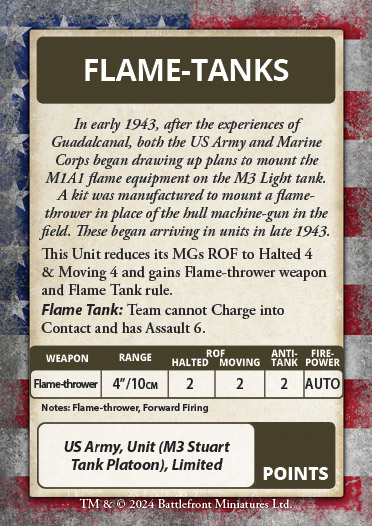
They both now have the option of firing Cannister Shot (excellent against infantry), with an 8” RoF 6 shot stationary/moving, there is also a Limited Command Card that can upgrade one unit with Flamers, losing a hull MG, which can be great versus dug-in infantry, gun teams or bunkers. They also have stacks of MGs, so murderous against infantry, which they were very effective against in actual combat. Overall it will be a cheap support formation for your force and a great distraction if played well, but the Green 5+ Skill and Reckless 2+ to-hit means they won’t be great in assault! But can certainly support one!
The Flame-Tanks Command Card below can make for an interesting unit, as it keeps its 37mm main gun and 4 MGs, but also gains 2 x 4” Flamer shots which automatically pins units when they hit, as well as re-rolling their saves and AUTO firepower. If combined with another unit assaulting in the same turn, it can heavily weaken a unit before an assault.
|
|
|
|
Supports
Your support is now a mix of US Marine and US Army units, with the better trained US Marine units having access to both the lighter 75mm Pack Howitzer, as well as the standard US 105mm M2A1 Howitzer. The US Marine 105mm Howitzer has a Veteran 3+ skill for ranging in, while the US Army crew only rates as a Trained 4+ Skill.
|
|

|
|
As you can see the US Army is relying on the US Marine Corps for most of its support. Which is historically accurate, as higher command did not think they would need much in the way of heavy artillery, ‘given the lack of heavy Japanese fortifications’, so they did not send any of their heavier howitzers with them. This was of course a major error, but they still benefit from the US Time-on-Target rule, which activates when you range in on the first try, making your opponent’s re-roll their successful saves.
|
|

|
|
|
|
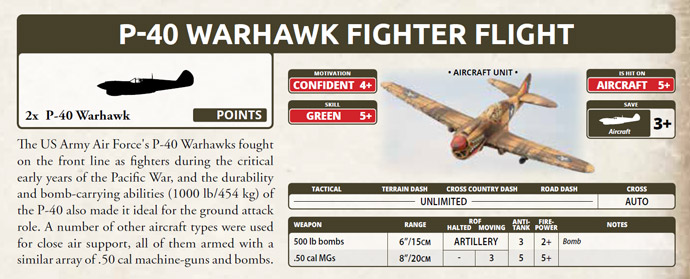
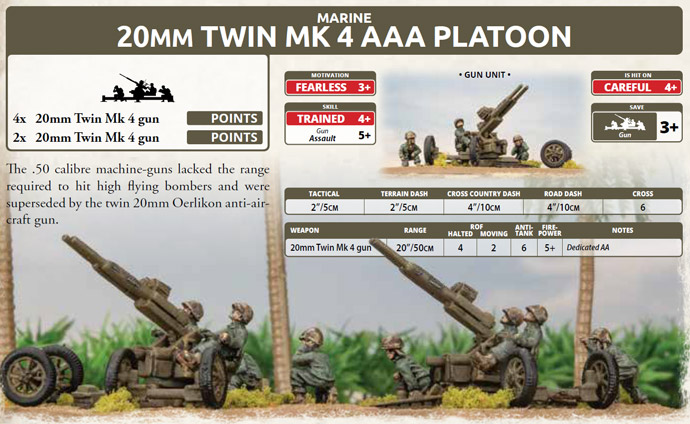
The US Army did have the US Army Air Force in the Pacific (P-40 Warhawk) which performed well later in the war, but was on a steep learning curve initially, hence the Green skill. While overall it is not a huge support diagram like some other factions, it has a lot of firepower, with two units of relatively cheap 20mm AAA platoons available, they give you a great base of fire, with a 3+ save, and an AT of 6, good against light armour, 4 guns gives 16 shots at 20” range.
|
 |
|
Your main Formation of a US Army Pacific force will be the humble Rifle Company, and I such a rugged, hilly and inhospitable location it should be no surprise. It was a gruelling theatre where disease took more casualties than battle. For units training for the green fields of Europe it was a big surprise, and was a struggle for units to come to grips with.
The US Rifle Platoon looks very green, but this is true of what happened historically, research how the US Army National Guard 32nd Infantry Division faced a heavily entrenched Japanese force in the Battle of Buna-Goa. It was chewed up and then pulled back to Australia and re-built with British equipment, with some Command Cards representing this.
There was more experienced US Army Divisions in the Pacific, like the 25th ‘Tropic Thunder’ Infantry Division, initially based in Hawaii, which were more used to the conditions, and first to deploy.
|
|
|
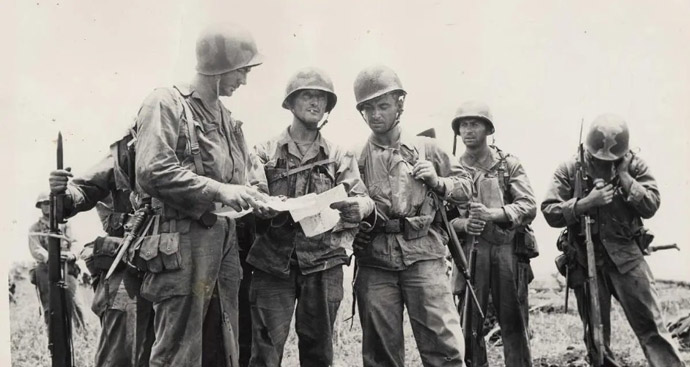
| US Army Riflemen - Note the camouflage painted helmets. |
|
The US Army Infantry
US Army Infantry Divisions in the Pacific were structured in what is called a ‘Triangle Division’ with three Regiments of three Battalions, and each Battalion made up of three Rifle Companies. Supporting Companies existed in each Battalion with Cannon Companies or an Anti-tank Company usually being placed in Regiments as needed. Additionally, Divisions had supporting Artillery Regiments and an Engineer Regiment or Battalion, they could also have a Tank Battalion attached for specific battles.
An infantry rifle company was equipped the same as other US Army Divisions at the start of 1941, with the M1 Garand Rifle and the BAR as a squad automatic weapon, being the basic tools of the twelve-man infantry rifle squad. A M1919 LMG could also be attached from the Weapons Platoon to boost their firepower. Heavier M1917 HMGs, 60mm Mortars and 3.7” anti-tank guns, with deadly cannister rounds for use against infantry. The company could also call on Regimental Support such as 105mm Field Artillery, AAA Platoons, and devastating naval gunfire support, which was often called in to deal with difficult Japanese positions or destroy a Japanese counter-attack.
|
|
|
|
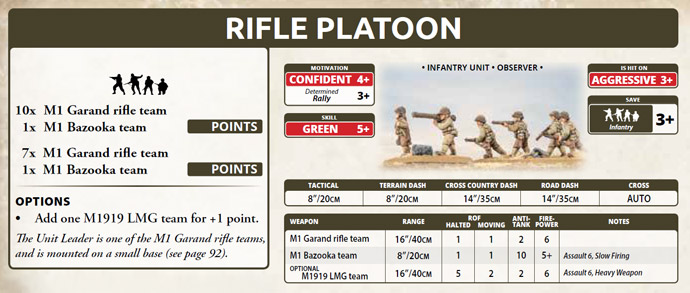
As you can see from above you get a lot of stands in a Platoon, and are reasonably cheap, they also have a bazooka, allowing some close in AT, that you can also use in assault, which most infantry doesn’t possess in mid war. But being Aggressive, and Green you are hit on 3+ and a low skill of 5+, so actually hitting in assault will be difficult, not to mention movement orders. Your best bet is to use your firepower to destroy the enemy before he reaches you, so adding an LMG for 1 point is a good pick.
Your support weapons are cheap and plentiful, you can take up to two of each support weapon platoon, so HMGs, mortars, and 37mm AT guns will help in keeping light armour and infantry supressed. The Rifle Company is excellent formation for defence, cheap with great firepower, and you should form two strong bases of fire on each objective, but you will struggle to actually capture any objective that is defended. Unless your opponent is silly enough to leave one unguarded, then you could use your fast M3 Stuarts to race up and claim the objective.
|
|
|
|
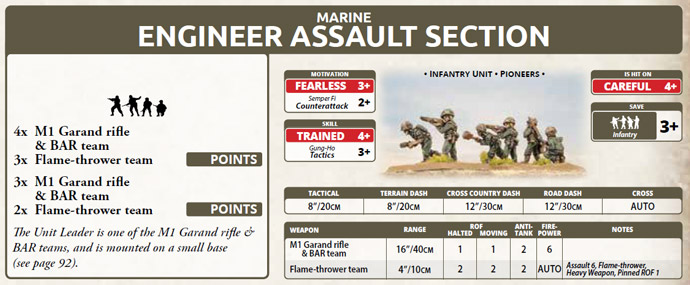
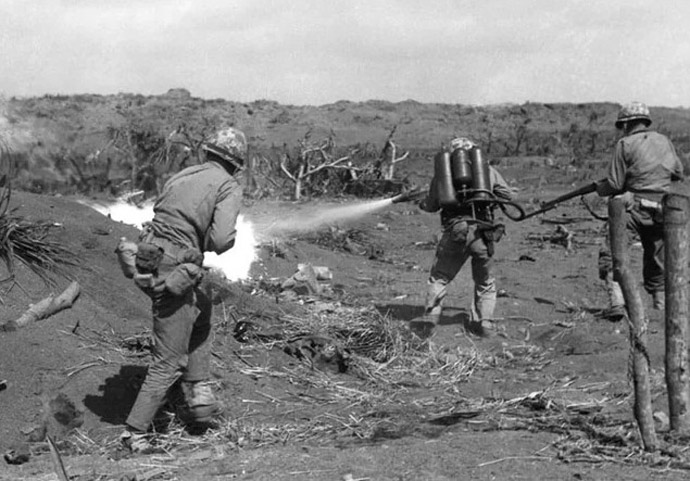
What you really need is a hard as nails unit to help you with assaulting a position, from your force support, it could be a US Marine Infantry platoon with flamers, or a Marine Engineer Assault section, both have the option of flamers, which can pin any unit it hits before an assault. Or you could bring an Allied Formation or unit, such as an Australian Independent Company Formation or Commando Section, these are Fearless units, with a Deadly Skill 2+ in assault, and will make quick work of a supressed enemy trying to hold an Objective.
|
|
|
|
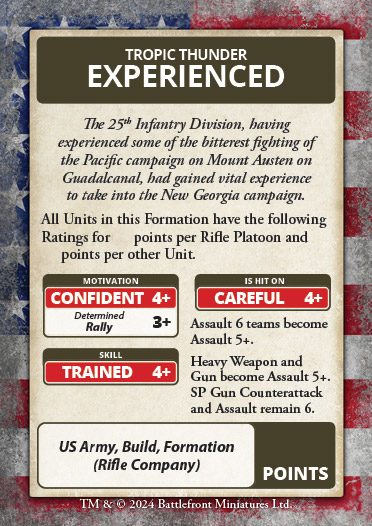
The other option is to upgrade your Rifle Company with a Command Card, to give them some better soft stats. One such card in the US Command Card pack is the Tropic Thunder Experienced Card. This card represents you taking a Force from the US 25th ‘Tropic Thunder’ Infantry Division, which was one of the first US Army Divisions to see combat in the Pacific and quickly gained valuable experience in fighting in the theatre and against the Japanese.
This card upgrades your to-hit, to Careful 4+, as well your skill to Trained 4+, which means you now a 50-50 to hit in assault and you are also a 50-50 when being shot at, if you are gone to ground, concealed and at long range, it makes you now 7+ to hit…. Much more survivable. This card is for your whole Formation though, so all units in your Formation must pay the upgrade cost, but it is worth it.
|
|
|
|
Putting Together a List
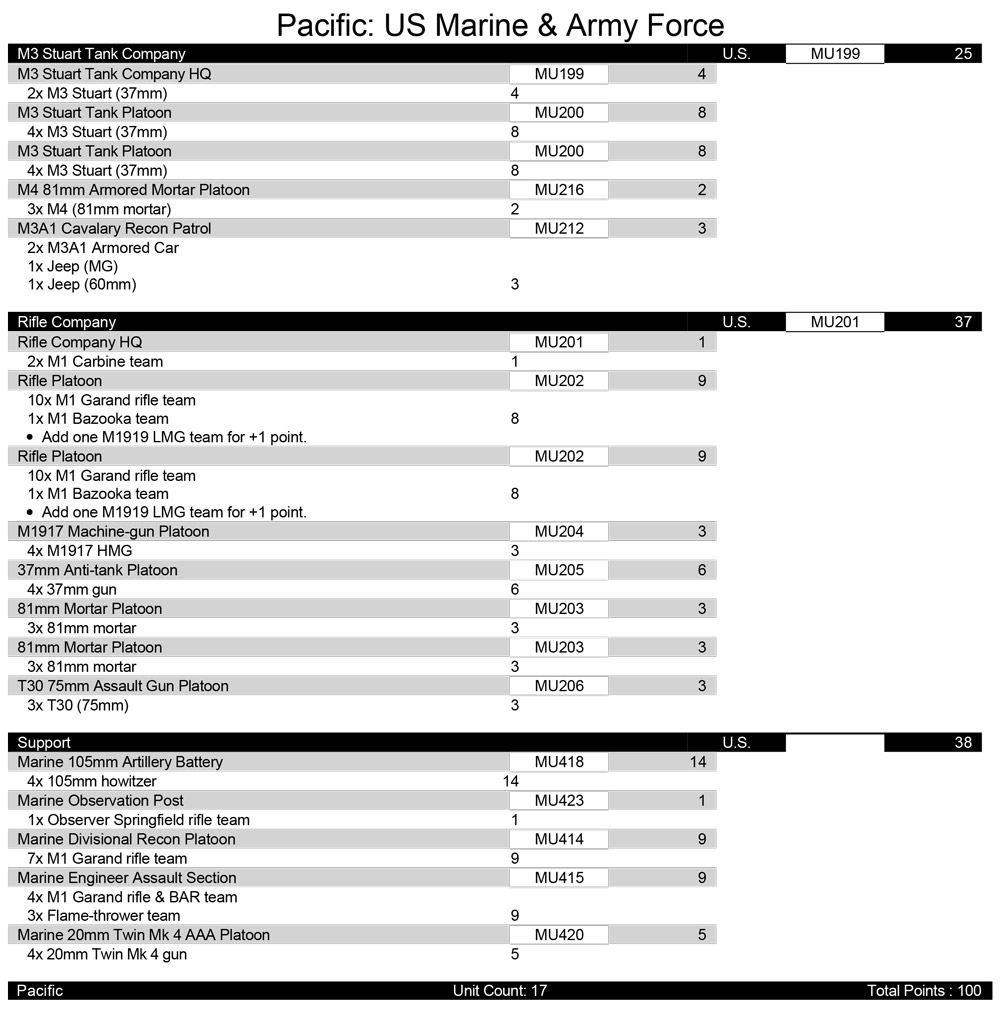
I have put together a Formation that I think will cover most bases, give you some good defence, as well as some striking power. Something to note is that there is not a lot of long-range high anti-tank available in most Allied Pacific lists; for two reasons, this is mid-war so historically most forces had not purposefully designed their forces to fight against heavy armour, and because it was not really needed. The Japanese did not field any heavy armour, and most medium or small anti-tank guns could defeat Japanese tanks, if you do need high anti-tank in a US Pacific list then the Marine Sherman or Wildcard T-55 Interceptor will be what you should take.
It's good to keep in mind the Forces in The Pacific are more based on what was in the theatre historically, and not necessarily balanced towards a tournament game. To me this is a great opportunity to play more games with a historical bent or battle recreation, and the extra terrain and specific Missions in the back of the book really help for you to do this. I would also recommend getting the Pacific – Beach Landing Pack which also has these Missions and rules, as well as a terrain pack which includes a Beach and Atoll Mat. You can still create a competitive list with this book, but it may require a bit more finesse to play.
|
|
|
| Click image to enlarge |
|
I have taken both the US Army Companies, you have a lot of firepower here, against light armour and infantry, but it does lack high AT, you could swap the M3 Stuart Company out for 3 Marine Shermans, or some Allied Grant/Lee tanks, to give you that long range mobile high anti-tank.
The Marine Div Recon and Engineer Assault platoons not only allow you to spearhead, but also gives you the ability to assault successfully, with the flamers suppressing the enemy before you get stuck in. Make sure to use all the other firepower in your force to soften up the enemy too, so mortars, artillery, and assault gun platoons. I also made the mortars two units of 3, as it costs the same, and gives you more templates, and use the two rifle platoons to hold objectives, until it becomes clear which enemy objective you will want to push on to.
|
|
|
|
The above force, is a large one with two Formations, so you should be able to be aggressive with your Stuarts, and let them help the marines to assault. Use your template weapons to suppress gun teams or artillery, or the unit you want to assault. You should have enough riflemen on your objectives to hold, unless they throw their whole force against you, then you can just claim their objective!
I hope this article helps you decide how you want to field a US Army Formation in the Pacific, and give you some ideas of what type of force you want. I really think it should be used in conjunction with either a US Marine Formation or Allied Formation like the Australian Independent Company Commandos to give you that harder hitting assaulting power that the US Army companies lack.
Happy Gaming!
~ Adam
|
|
|
|