|
|
Winter Weather and Terrain
Winter Terrain, Weather and Battlefields
Bringing The "Brrrr" To Your Battlefield |
 |
Terrain
European winters present the battlefield commander with a number of challenges over and above the normal hazards of terrain, such as snow covered woods, muddy and icey roads, and frozen waterways. |
|
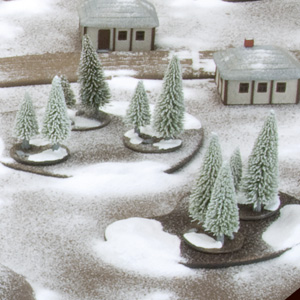
Forests & Woods
Large parts of Europe are Heavily wooded making this country difficult to cross. When combined with the snows of winter only the most skilled woodsmen can find their way with any certainty or speed.
Woods are Difficult Terrain. Tanks moving through a wood risk getting stuck. Woods are Tall terrain. Teams at the edge of a wood are Concealed.
Check out the Small Pine Wood (Winter) Battlefield in a Box here...
|
 |
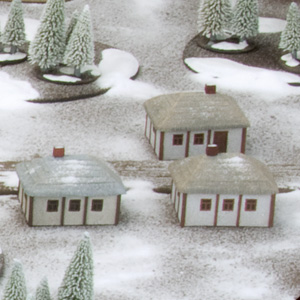 |
Villages
Europe is dotted with small villages and farmsteads. A village or Farmstead consisted of wooden, stone, or brick houses depending on where you were in Europe.
Open Ground
Between the forests, the land is broken by fields, pastures, and areas cleared by logging.
Open Ground is Cross-country Terrain.
|
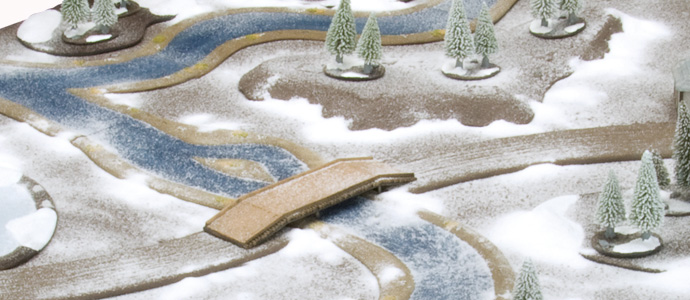
Roads & Tracks
Many of the roads of eastern Europe are unpaved gravel or dirt. While in western and central Europe paved roads are more common. |
 |
|
Streams & Rivers
The Europe is cut through with winding rivers and streams.
When they are not frozen over, Streams are Difficult Terrain with Fords where Tracks cross. Rivers are wider than streams and can be Deep so Immpassable for Tanks/Guns and Difficult Terrain for Infantry. Fords across Deep Rivers are Difficult Terrain, but most Roads cross by Bridges.
Frozen Rivers and Ponds
Frozen rivers, streams, lakes, and ponds posed their own threats, not least of which was the temptation to cross them with armoured vehicles to outflank the enemy.
For light vehicles, such as trucks, jeeps, and other utility vehicles, a frozen river is easier to cross. For these vehicles a frozen river is rated as Cross-country terrain.
However, a crossing is far more risky for armoured vehicles. When an Armoured Tank Team tries to cross a frozen river, it must roll a die.
- If the total is less than the vehicle’s Front armour, the ice gives way under the vehicle’s weight and the vehicle is Destroyed.
- Otherwise the vehicle safely navigates the river and it may continue as normal.
Check out the Frozen Ponds Battlefield in a Box here...
|
|
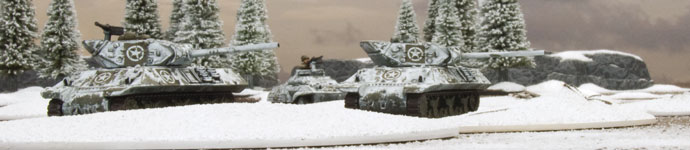
Snow
The winters Europe can be harsh. Snowfall adds another difficulty to the fighting. The snow covers the ground, making it hard to locate streams, fences, and uneven ground. This means troops have to be more cautious when moving in snow covered terrain.
All teams treat snow-covered Roads as Cross-country Terrain, and all other snow-covered Terrain as Terrain Dash.
Snow Drifts
During wild Winter storms the snow can collect against obstacles such as fences, buildings, natural rises, and stands of trees.
All teams treat Snow Drifts as Difficult Terrain.
Check out the Snow Drifts Battlefield in a Box here...
|
|
|
Ice
Packed snow and ice make moving vehicles a risky affair. Black ice, which is extremely hard to spot, makes honest men out of even the most reckless drivers!
If a vehicle moves more than 8”/20cm in the Movement Step, at the end of its movement roll a Skill Test for that vehicle.
- If successful, the vehicle navigates through the ice and carries on unharmed.
- Otherwise, the vehicle slips on the ice and stops moving immediately. Even if the team is still where it started, it has now moved.
|
 |
|
Winter Weather
Your Battlefield
These rules are optional. Feel free to use all of them, but be aware that this can lead to slower and longer games.
If that isn’t your style but you’d still like to add some flavour to your battle, go ahead and choose a few of the rules on this and the previous terrain pages to use in your game and leave the others for another time and another battle.
Snow Storm
Snow storms are frequent during the Winter in Finland and Russia, and can cause confusion and frustration.
If both players agree, your battle can take place during a snow storm. The game is played under the Night Fighting rules (see page 113 of the rulebook). The mission is played using the Dawn rules (see page 113 of the rulebook).
Blizzard
Blizzards are a more serious breed of snow storm. They can strike suddenly, delivering a pile of deep snow within a matter of minutes.
If both players agree you can decide to risk having a blizzard strike your battlefield.
If a Blizzard could strike in your battle, roll a die at the start of each player’s turn. On a 1, the Blizzard strikes. That turn and those following are played under the Night Fighting rules (see page 113 of the rulebook).
Instead of using the Night Visibility Table, use the Blizzard Visibility Table below to find out how far your teams can see in the Blizzard.
Players continue to roll at the start of their turn. On a 5+ the Blizzard dies down, and the rest of the game uses the normal visibility rules.
If the game is not already using the Snow-covered Terrain rule when the Blizzard strikes, the rest of the game is played with them in effect.
Blizzard Visibility Table
|
| Dice Roll |
Distance |
| 1 or 2 |
4" / 10cm |
| 3 or 4 |
8" / 20cm |
| 5 or 6 |
12" / 30cm |
|
Rules Download
You can download a handy PDF will all of these rules, along with some suggestions about how you can theme your battlefields for the Ardennes and the Battle of the Bulge below.
Building a thematic looking winter table and army can make for an exciting game where you need to not only account for the enemy and their actions, but also the hazards of a battlefield that is constantly looking to cause you trouble!
Just remember, fortune favours the brave... your Stuarts might plunge in to the icy river and be destroyed, or they might flank the enemy and cause confusion and casaulties far in excess of any losses you may suffer!
Download the Winter Terrain PDF here...
|
 |
|
|