|
|
 |
|
|
Painting Paper Panzers - Part 2
 |
Painting Paper Panzers - Part 2
by Rubén Torregrosa
In the previous article, we explored how to create a disruptive camouflage using masking tape and highlighted each camo spot using an airbrush. After applying the decals and sealing the tank with glossy varnish, we used an enamel wash to bring out the recessed and details. Once the excess wash was removed, the tank was re-sealed with matte varnish.
Check out the E-100 in the online store here...
|
|
Building on that foundation, this second part will focus on applying weathering effects. While we have already covered techniques like chipping and dust effects using pigments, we will now introduce some new methods, such as using oils to create realistic streaking and dirt accumulation effects.
|
|
Step 1: Chipping I
|
|
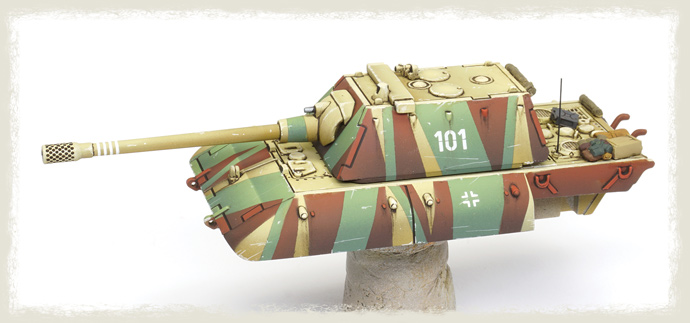
The first weathering effect we will address is chipping, which is done in two stages: light or superficial chipping, and dark or deep chipping and scratches. We begin with the superficial impacts using a lighter tone of the tank’s base color, which in this case is dark yellow or Dunkelgelb. Although the technically correct color for superficial chipping would be red primer, we will later use a dark brown for the deeper chipping to partially resemble that color.
For the light chipping, we use the highlight color that was previously applied to the dark yellow (a mix of 80% Dunkelgelb ATOM-20012 with 40% Matt White ATOM-20000) and add a bit more white. Using a fine brush, we create random dots across the tank, primarily focusing on edges and high-wear areas such as hatches. We can also create scratches by painting thin lines along the sides of the tank to resemble the impact of branches or other objects. We only create superficial chipping effects with this color on the dark yellow and green camouflage spots, not on the hull red, which is the actual primer color.
|
|
|
|
Step 2: Chipping II
|
|
Following the previous approach, we now create the dark or deep chipping effects using a dark brown color, such as Chipping ATOM-20064. This color serves a dual purpose: representing both the exposed primer and bare, rusted metal. We apply it in the same manner as before, placing it in contact with or slightly overlapping the light chipping effects, but without completely covering them. The contrast between the light and dark colors will help create a three-dimensional effect. It is not necessary to cover all the previous light chipping effects. This time, we also apply it to the hull red sections. It is important to keep the chipping effects very small, in line with the scale of the model. Remember, when applying weathering effects, less is often more.
|
|

|
|

|
|
Step 4: Streaking Effects With Oils I
|
|
We have previously discussed the advantages and disadvantages of using oil paints when painting tanks (see Bringing a T-64 to Life Using Oils). The key points are that oils take significantly longer to dry compared to acrylics (hours versus minutes), allowing for easy blending. However, they require the use of an organic solvent, such as Enamel Odourless Thinner A.MIG-2019, the same one used for the enamel wash.
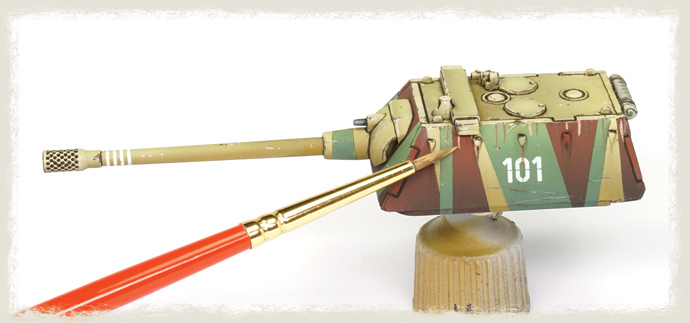
To create streaking effects, we simply paint thin lines on vertical or inclined panels, following the natural path where gravity would pull water and dirt downwards. We use different oil colors depending on the effect we want to achieve and the color of the surface. For a dust and dirt effect, we choose a couple of brown tones, a very light brown to represent dust, and a reddish tone to suggest rust. These streaks are applied randomly across the surface, with a general guideline of using lighter oils on darker surfaces and vice versa for contrast. The oils used here were Oilbrusher Earth A.MIG-3514, Dark Brown A.MIG-3512, Dust A.MIG-3516 and Rust A.MIG-3510.
|
|
|
|
Step 5: Streaking Effects With Oils II
|
|
Immediately, without waiting, we use a brush moistened with odorless enamel thinner to blend the oils (making sure to brush off most of the thinner on a piece of paper or cloth). We apply the brush strokes vertically, dragging the paint from the top to the bottom to create longer streaking effects. Our goal is to achieve subtle effects, so do not worry if most of the paint is removed. However, it is important to do this gently to avoid completely removing the oil paint.
|
|
Step 6: Dirt Effects I
|
|
Next, we move to the horizontal surfaces, where dirt and rust tend to accumulate in corners and around details. Using the brown and red oils we used previously, we apply a small amount of paint to the areas where we want to create the effect, such as around the hatches and the back of the turret.
|
|
Step 7: Dirt Effects II
|
|
Once again, we load a brush with odorless enamel thinner and begin blending and spreading the oil around the application area. We use a random motion to create a more realistic effect. Note that this time we apply the brush with plenty of thinner, unlike before when the brush was almost dry.
|
|
Step 8: Oil Work
|
|
We repeat the same process on the entire tank, working on both vertical and horizontal surfaces as previously described. Since we are using oils, we can always completely remove the paint with thinner and start over if needed. Alternatively, we can wait 30 to 60 minutes and apply a second layer of effects. In any case, as with the chipping, it is important to create small and subtle effects, as this is the key to effective weathering.
|
|
Step 9: Dust Effects With Pigments I
|
|
We let it sit for 30 to 60 minutes before continuing. The next weathering effect is dust, which is best achieved using pigments (colored dust). There are various options for working with pigments. In this case, we mix them with odorless enamel thinner to create a wash (as explained here Becoming a Storyteller: Weathering a BMD-2) and apply a bit on the lower part of the side skirts. We use an old brush and apply the pigment in a random motion, avoiding the creation of any patterns.
|
|
Step 10: Dust Effects With Pigments II
|
|
We let it dry completely (we can use a hairdryer to speed up the process) until the pigments regain their light and dusty appearance.
|
|
Step 11: Dust Effects With Pigments III
|
|
Then use an old brush to remove the excess and blend the pigments in the lower part of the tank.
|
|
Step 12: Splash Effects
|
|
Finally, we can add more interest by creating splash effects using enamels and dedicated products, as we described earlier (Painting the WWI German AV7 Tank: How To Create Realistic Mud Effects on Tanks). We use at least two different colors. The light color will represent dry splashes, while the dark color will represent wet ones. We pay special attention to the section where the side skirt is missing.
|
|
The Tracks
|
|
Although the tracks were painted simultaneously with the tank, we have addressed them separately in this tutorial for clarity. This could also serve as a stand-alone tutorial for learning how to paint tracks, regardless of the tank.
|
|
Step 1: Base Colour
|
|
We paint the tracks in dark yellow, using the same highlighting technique as before by applying the highlights toward the upper parts. Then, we block in the tracks with a mid brown or gray, for example, by mixing a 1:1 ratio of Zimmerit ATOM-20144 and Chipping ATOM-20064.
|
|
Step 2: Metallic Shine
|
|
We apply a dry brush technique using Drybrush Light Metal A.MIG-0621, highlighting the raised details of the tracks. Remember to brush off most of the paint on a cloth or paper before applying it to the tank.
|
|
Step 3: Sealing With Gloss Varnish
|
|
We protect the previous work and prepare the surface for the next step, the wash, by applying a layer of glossy varnish using the airbrush.
|
|
Step 4: Enamel Dark Wash
|
|
We apply an enamel-based wash to enhance all the recesses and details, using a dark brown color. For simplicity, we use the same one we applied on the tank: Dark Brown Wash for Green Vehicles A.MIG-1005.
|
|
Step 5: Remove Excess Wash
|
|
After allowing it to sit for 30 to 60 minutes, we remove the excess wash with a brush or cotton swab moistened in odorless enamel thinner.
|
|
Step 6: Chipping Effects
|
|
We create chipping effects and scratches using a dark brown color, such as Chipping ATOM-20064. We can simply paint a line around the edges of the wheels using the side of the brush.
|
|
Step 7: Dust Effects I
|
|
To create dust effects and accumulation between the details of the tracks, we use a wash made with pigments, as we did when applying dust effects to the side skirts of the tank (also, check this Becoming a Storyteller: Weathering a BMD-2). We apply enough of the wash to ensure that there is a sufficient accumulation of pigment. Note that the consistency of the wash should resemble that of milk. If there is too much pigment, you will end up creating a thick -and unrealistic- layer. It is better to start with less than you think you might need and add more if necessary.
|
|
Step 8: Dust Effects II
|
|
We let it dry completely until the thinner is completely evaporated and the pigments recover their original dusty appearance. We can use a hairdryer to speed up the process. Then, we use a cotton swab or old brush to remove the excess of pigment while spreading it around.
|
|
Step 9: Splash Effects
|
|
For consistency, we also apply splash effects on the tracks (see Painting the WWI German AV7 Tank: How To Create Realistic Mud Effects on Tanks). We use only 'wet' effects in a dark color, as the enamel will blend with the pigment, creating an interesting result.
With this final step, our tank is ready. We can attach the tracks using instant glue, as plastic cement will not work in this case due to the layer of paint covering the plastic.
|
|
|
|