|
|
 |
|
|
Painting Paper Panzers - Part 1
 |
Painting Paper Panzers - Part 1
by Rubén Torregrosa
The “What If” tanks open up endless possibilities for experimenting with color schemes and camouflage. Since these tanks never existed, the creative freedom is limitless. However, it is important to think logically and consider historical facts when designing your paint scheme.
In this tutorial, we will explore how to paint a disruptive camouflage, or “splinter,” on a German paper panzer E-100. With its large vertical and horizontal surfaces, we will also learn how to use oils to create streaking effects and simulate dirt accumulation, adding a layer of realism to our models.
Check out the E-100 in the online store here...
|
|
This is likely the most challenging painting guide I have presented in this series, as it involves a detailed masking process for the camouflage and requires polishing the basic acrylic paint job with oils. However, if it were easy, you would not have the opportunity to learn many new techniques. Remember, you do not have to follow every step in this guide; feel free to pick and choose what you find most useful or interesting.
This guide builds upon the techniques described previously (Crafting Soft-Edge Camo on a German Sd Kfz 251 Part Iand Unlocking the Enchantment of Highlights: Creating Contrast in 15mm Vehicles) especially the highlighting method used (color modulation). Using masks, we will create a hard-edge camouflage that will also feature highlights.
|
|
Step 1: Preparation
|
|
We begin by assembling all the parts of the tank using a dedicated glue for plastic, commonly known as plastic cement. Avoid using instant glue (cyanoacrylate) for plastic, as it can hinder assembly; this type of glue crystallizes, while plastic cement works by melting the pieces together.
When preparing your platoons, it is a good idea to customize your tanks a bit. For this model, I added 3D-printed stowage and boxes, removed one of the skirts, and adjusted some details using a 2mm PVC sheet. Additionally, you can create antennas using a 0.2mm nickel-silver rod (Albion Alloys). For these accessories, instant glue works well.
|
|

|
|
Step 2: Primer
|
|
A crucial step before starting the painting process is applying an undercoat or primer. This will help the paint adhere better and increase its durability. In this case, we use a neutral grey color, which serves as an ideal base for any other colors, as they will easily cover it.
|
|
Step 3: Olive Green Camo Shadow
|
|
Once we have decided on the camouflage pattern, we begin painting the first color. This camouflage design involves applying the disruptive pattern only on the vertical surfaces, while the horizontal panels will be painted in plain dark yellow.
Focusing on the camo panels, I decided to start with green, as it will be one of the dominant colors. For this, we apply an even layer of Deep Green ATOM-20098, diluted with 30% acrylic thinner and using an airbrush (from now on, whenever I mention the airbrush, I will be using this thinning method).
|
|
Step 4: Olive Green Camo Base
|
|
Next, we airbrush the first highlight or base color using Green Base ATOM-20083. We apply the first highlight to the upper part of the vertical panels, following the color modulation technique (Crafting Soft-Edge Camo on a German Sd Kfz 251 Part I). In most cases, there is no need to use masks, as we can simply tilt the model to airbrush just a corner.
|
|
Step 5: Olive Green Camo Highlight
|
|
We airbrush the final highlight using a lighter green tone by mixing Green Base ATOM-20083 with 20% Dunkelgelb ATOM-20012. Again, we focus on the upper parts that were pre-highlighted in the previous step, reducing the painted area. If you do not have an airbrush or prefer a simpler approach, you can easily apply these colors using the drybrush technique (as we did here: Bringing a T-64 to Life Using Oils).
|
|
Step 6: Masking I
|
|
With the first camo color laid down, we create the initial layer of masks. Remember, the areas we cover will remain green. Using masking tape (Tamiya and AMMO) of various thicknesses, we create disruptive lines only on the vertical panels. A sharp knife can be used to cut along the upper edge, close to the upper horizontal panel. This task is simple but tedious, so please be patient.
|
|

|
|
Step 7: Hull Red
|
|
The next camouflage color is the hull red, which was the undercoat color that German tanks typically had before applying the final paint. We will follow the same procedure as for the green, applying highlights in three steps: shadow, base, and highlight. For the shadow, we use Black Brown ATOM-20063, while the highlight is done with Rotbraun ATOM-20046. The middle tone, or base color, is achieved by mixing these two colors in a 50/50 ratio. It is crucial to apply the highlights in the same areas as we did with the green; otherwise, the color modulation will not be effective.
|
|
Step 8: Masking II
|
|
We repeat the masking step, ensuring not to cover the hull red areas. The goal is to restrict the dark yellow, or Dunkelgelb, to thin camouflage lines on the vertical panels.
|
|
Step 9: Dark Yellow
|
|
We complete the camouflage by airbrushing the final color, Dunkelgelb, or dark yellow. We will also use this color to paint all the horizontal panels (the upper part of the hull and turret), applying the highlight towards the back and/or front. We also paint the tracks and gun barrel. Again, we will use three layers: shadow, base, and highlight. For the shadow, we mix 80% Dunkelgelb ATOM-20012 with 20% Chipping ATOM-20064. The base will be pure Dunkelgelb ATOM-20012, and for the highlight, we mix 80% Dunkelgelb ATOM-20012 with 20% Matt White ATOM-20000. Remember to thin these paints with 30% acrylic thinner when using an airbrush.
|
|
Step 10: Removing The Masks
|
|
This is the most satisfying part: carefully removing all the masks. Do not worry if some paint goes a little outside the camouflage spots.
|
|
Step 11: Last Highlight
|
|
We complete the color modulation by using a brush to highlight all the small details, such as rivets, hatches, and small panels. The idea is to create contrast. We will use three colors, one for each camouflage. For the green and red areas, we mix the corresponding lighter color with a little bit of Dunkelgelb ATOM-20012. For the dark yellow parts, we add an additional 20% Matt White ATOM-20000 to the previous mix.
|
|
Step 12: Stowage and Accessories
|
|
Once the camouflage is complete, we paint the stowage and accessories using their appropriate colors, such as mid-tones. For this, we use acrylic paints and a thin brush. The exhaust is painted red brown to simulate rust. It is important to choose colors that create contrast, allowing them to stand out on the tank without being exaggerated.
|
|
Step 13: Decals and Sealing
|
|
Then, we apply a couple of thin layers of glossy varnish before applying the decals (How To Apply Decals). Finally, we apply another layer of glossy varnish to protect and integrate the decals, as well as to facilitate the application of the wash in the next step.
|
|
Step 14: Enamel and Dark Wash
|
|
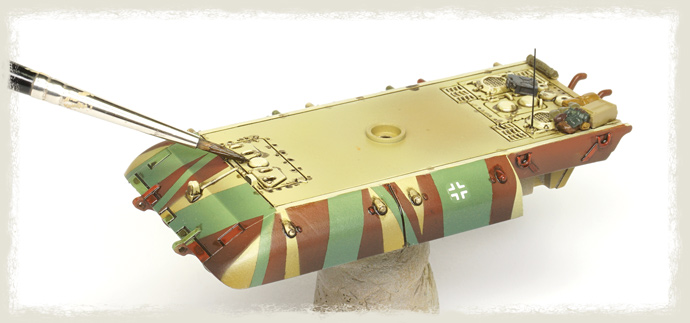
To highlight all the recesses and details, we apply a selective wash. For this, we will use an enamel-based wash. While it requires the use of an organic solvent, such as white spirit or turpentine, it offers the ability to remove excess paint, leading to very clean and well-defined results. This is because enamels take hours to dry, unlike acrylic washes, which dry in seconds and do not allow for such adjustments. For this step, we begun using a dark brown wash, like A.MIG-1005 Dark Brown Wash for Green Vehicles, applied exclusively to the recesses and corners using a brush. We let it dry for 30 to 60 minutes.
|
|
|
|
Step 15: Removing Excess Enamel Wash
|
|
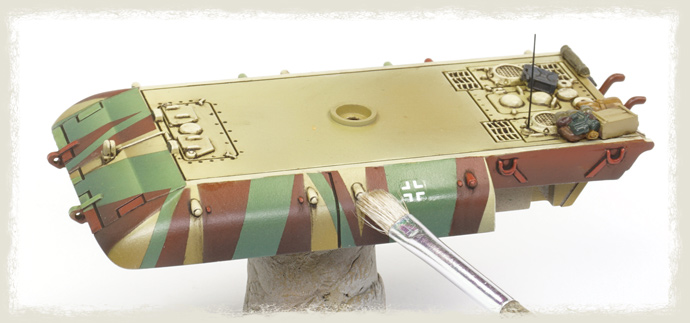
After 30 to 60 minutes, we use a brush or cotton swab moistened with enamel odorless thinner to gently rub the surface and remove any excess wash. On vertical panels, a flat brush can be used to drag the paint downward, creating subtle streaking effects in the process. Sometimes we may remove too much wash, either because the recess is not deep enough or we over-brush the area. If this happens, we can use a fine brush and dark brown acrylic paint to carefully outline those parts for added definition. This will enhance the definition, and in turn, the contrast. This is key when painting 15 mm models.
|
|
|
|
Step 16: Integrating the Decals and Eliminating the Glossy Finish
|
|
We allow the traces of enamel odorless thinner to evaporate for 10-20 minutes (this process can be sped up with a hairdryer). Once dry, we apply a couple of flat varnish layers over the entire tank using an airbrush. This will eliminate the glossy effect and fully integrate the decals into the surface.
|
|
Part One Conclusion
|
|
In the next part of the tutorial, we will dive into creating weathering effects using oils for realistic streaking and dirt accumulation effects. See you in the next part!
|
|
|
|