|
|
Narrative Wargaming with the 116th Panzer Division “Greyhound”
 |
Narrative Wargaming with the 116th Panzer Division "Greyhound"
By Chistopher DeRosa
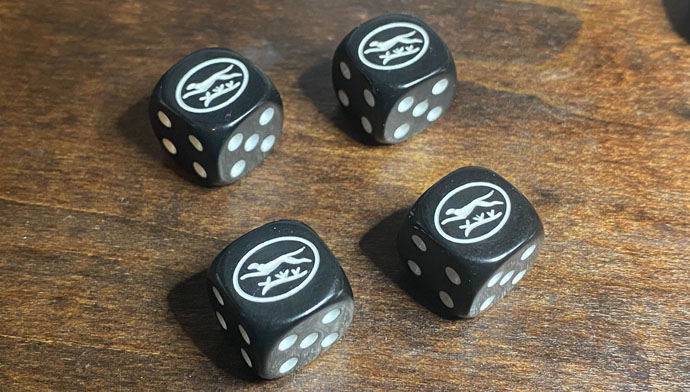
The 116th Panzer Division “Greyhound” is easily my favorite division to play in Flames Of War. I originally commanded them over the course of a D-Day campaign during the Covid-19 lockdowns, and they quickly became my go-to force. My opponent in this campaign even gifted me a set of custom dice with the Greyhound logo in place of the six. The mechanical benefit that the 116th provides is useful for list-building, but the narrative and historical context of this division is where much of my personal enjoyment comes from. Historical wargaming serves another role as a teaching tool. It presents the opportunity for players to not only learn about history, but immerse themselves in it.
|
|
At first glance, my preference for the 116th may be surprising given their less than stellar performance during World War Two. They were an ill-fortuned division, raised in a desperate bid to slow the allied advance at Normandy. The 116th occupies a unique historical space, formed from the 16th Panzergrenadier Division and the 179th Panzer Reserve Division, they were on the backfoot from their first moments in action and in truth, for most of their existence. They were given their moniker of Greyhound or Windhund along with the striking logo of a silhouette of a greyhound dog for the sake of troop morale. Their depiction in Flames Of War highlights the desperate kind of fighting retreat that the 116th so often was forced into, which creates a melding of wargaming and history.
|
|
|
| Christopher's custom dice featuring the Greyhound logo of the 116th Panzer Division. |
|
Historian Martin Blumenson writes in his book Breakout and Pursuit that during the allies push to the Seine in 1944 that "The 116th Panzer Division had one battalion of infantry (perhaps 500 or 600 men), 12 tanks, and no artillery" (Blumenson 577). While they were reinforced and diminished several times over the course of the war, and took many casualties in the fighting following the D-Day landings, the 116th’s resources were limited, stretched thin by the scarcity that plagued much of the German war effort as the allies marched on Berlin.
|
|
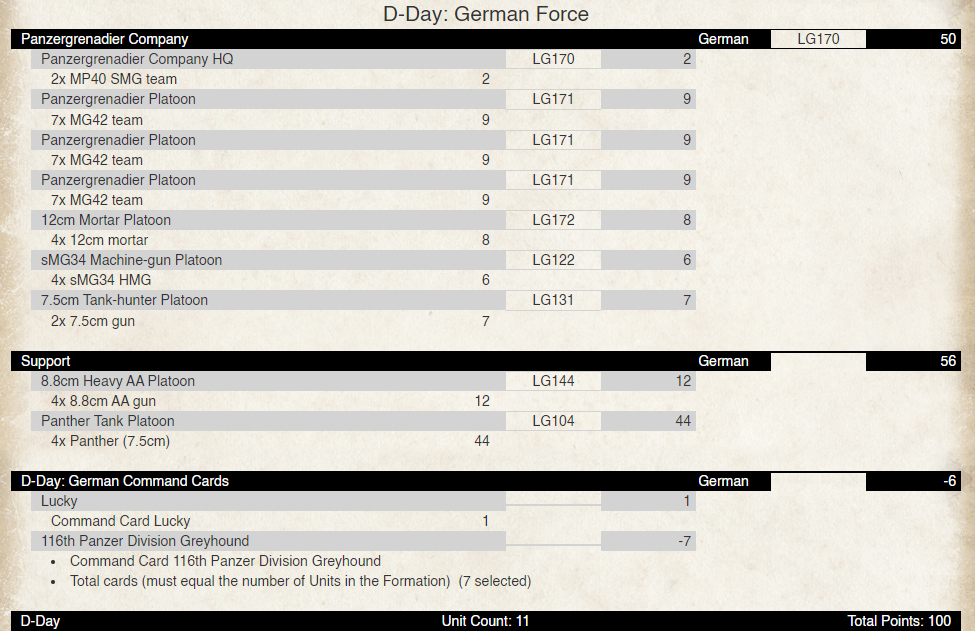
So what then, is the fun of playing the 116th? Turning to the Greyhound division’s rules in Flames Of War, their command card reduces their formation’s last stand rating as well as reducing their tactics rating in return for a one point discount on units. In doing so, this replicates the 116th’s situation in the war, creating a narrative of desperation in the games they are played in. Hugh Cole states in The Ardennes: Battle of the Bulge that "The 116th had fought itself out in almost continuous battles during the withdrawal across France and the Defence of the West Wall" (Cole 194).
|
|
In game terms, discounted units are always welcome, and the division encourages taking many small units to maximize the points that the player can save. Ultimately, it is the 116th’s penalties that go even further at creating this historically flavorful force. The penalty to their last stand rolls is difficult to play around and can cost an incautious player victories. It necessitates that the formation commander try in vain to be in multiple places at once. Even with his reroll, statistically there is the very real chance of a depleted unit running from the field. It also has historical basis considering the division’s notable retreating actions such as the ceding of the city of Düsseldorf, and their later retreat across the Rhine. As these soldiers were recruited right from the Eastern Front, their morale was already low, and this is represented in their reluctance to stick around on the tabletop.
|
|

|
|
In The Siegfried Line Campaign, Charles Macdonald notes of the Greyhound Division during the battle of Aachen that "Among German commanders, the only hope of relieving Aachen rested with the counter attacks by the 3rd Panzer Grennadeir and 116th Panzer Divisions. In reality, this was a fairly vain hope" (Mcdonald 304). This assessment of the 116th may give context for the lower tactics rating of the division in Flames Of War. Additionally, in Flames Of War the 116th prefers defensive engagements where its tactics rating will be less impactful, and its worsened last stand rating can be hidden away in foxholes and cover. Even after the entire division was committed to the battle of Aachen, Mcdonald notes "The Germans might have noted further than even though the entire 116th Panzer Division had arrived by 14 October, that division had been able to accomplish nothing offensively" (Mcdonald 304). Commanders of the 116th on the tabletop can learn from these historical lessons.
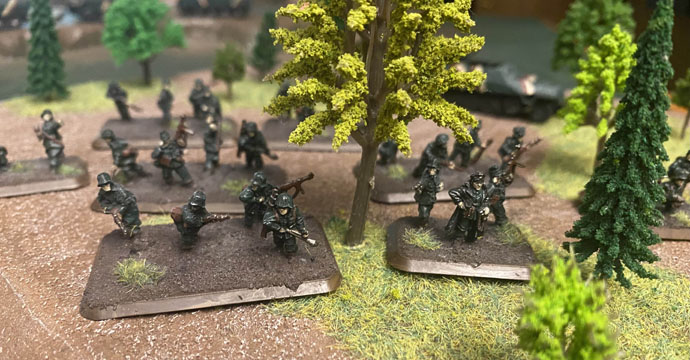
This is not to say that the 116th had no successes in the war. Mcdonald credits the division with a decisive victory in defense of the village of Würselen, stating that "Here sat the second of the 116th Panzer Division’s panzer grenadier regiments, the 156. Although devastating fire from automatic weapons drove back one of Company E's attacking platoons, the other struggled on... Then the panzer grenadiers emerged from a mine shaft in the rear of the platoon. Only six of the Americans ever made their way back" (Mcdonald 306). This seems to mirror the play style that the Greyhound division favors in Flames Of War; a defensive battle where the weight of fire afforded through discounted units, and cannily-placed ambushing units can bring victory.
|
|
|
|
I have found that focussing on this narrative and storytelling side of wargaming is the most fulfilling way to play Flames Of War for me. To this end, the 116th fits this mold perfectly. Even panzergrenadiers with their impressive base stats and weapons become frightened and war-weary with this card. It is easy to boil down stat cards and dice rolls to nothing but a game of numbers, but Flames Of War excels at telling the stories of these historical formations through minor tweaks and changes on their command cards.
|
|
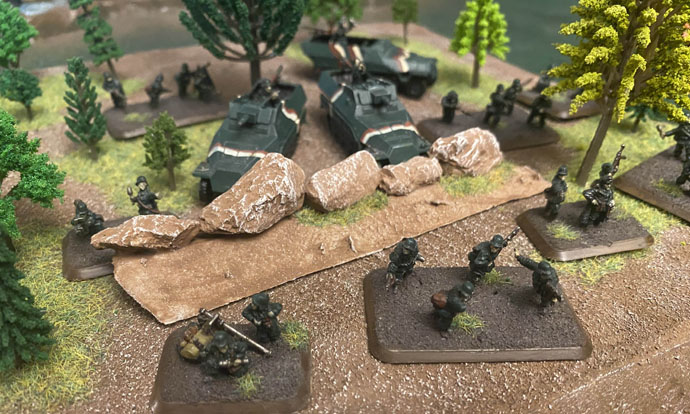
To this end, the 116th are especially rewarding to play in asymmetrical missions of defense and maneuver. This allows a player to recreate the sorts of holding actions and retreats that the 116th often conducted, and allows the strategic quirks of the division to shine. The discount on formation units means more infantry and guns for defensive lines, but there is always the risk that these more numerous units will flee from their low last stand rating, and that their formation commander will not be able to benefit as many units with his rerolls. It is a great tactical challenge for players of this division.
|
|
What’s more, playing as the 116th serves the important function of truthfully representing history in wargaming. There is the pervasive myth of the German Wehrmacht as a force of elite and fearless soldiers who only lost the war either from the Soviet Union’s weight of numbers, or the manufacturing power of the United States. Playing as the 116th dispels this notion, it refutes the historical myth. The Greyhound division were not a legion of übermenschen, they were the frightened, exhausted soldiers of a murderous regime, and this is the story they tell on the tabletop. It is a grim, bloody story, but one that is told quite well through rules and gameplay.
~ Christopher
|
 |
|
|
| Chistopher's 116th Panzer List (Click to enlarge) |
|
|