|
|
Beasts of the Battlefield
 |
Beasts of the Battlefield
By Kyle Perry
WWII saw numerous developments in technology and warfare. From large massed formations of armored vehicles to enormous defensive fortifications stretching hundreds of miles long. But with these advancements, new weapons were needed by the various powers to break through them.
Early in 1942, design work began on a new German super heavy tank, a Wunderwaffe (Wonder Weapon), by the Porsche company. It was to be 100 tons, heavier than any other tank in existence with suitable firepower and protection for its size. This design would become the Maus.
|
|
The tank was to be used with the combat proven independent Schwere Panzerabteilungs (Heavy Tank Battalions). First deployed in Africa and then both the Eastern and Western fronts, these units were the main recipients of the Tiger I and Tiger II tanks during the war. These battalions were incredibly efficient, each racking up a positive kill to loss ratio, with the 502nd for example knocking out 13 enemy vehicles for every one of their own that was knocked out or abandoned. The Maus was slated to augment these units' capabilities even further to shocking effect.
The largest tank ever designed at the time, it went through several iterations before landing on its final design. Equipped with a 128mm KwK 44 main gun, capable of destroying any Allied armored vehicle in production at the time, including at extreme ranges. It also boasted a 7.5cm support gun, suited for dealing with infantry formations and lightly armored vehicles, allowing ammunition for the 128mm main gun to be saved. Defensively it featured 9.7inches of armor at its thickest point, as well as an MG34 to help deal with infantry that moved in close to the tank. Sporting a crew of six, this behemoth, when designs were completed and prototype production began, finally weighed in at 188 tons. But further plans and improvements had already been discussed and planned, including the possibility of mounting a 20mm anti-aircraft gun onto the top of the turret to provide a self-defense capability against Allied ground attack aircraft.
Its intended use was to stop determined Allied attacks and to lead counter attacks to break through the lead enemy units, regaining the upperhand in the armored warfare. As the war dragged on, this became a standard German doctrine, counter attacking every Allied attack on their lines in hope of reversing their gains, and as things progressed, the German need for weapons to help push back these Allied attacks only grew. Initially planned to be able to produce ten vehicles a month, this was quickly curtailed and then stopped to only produce two prototypes, due to limited war material and concentrated Allied bombing of German industry. By war's end, there were only two chassis and one turret produced.
After the war, the two chassis and one turret were captured by the Soviet forces who assembled one working tank and brought it back to the Soviet Union for testing. The behemoth would later be sent to a museum where it is still kept today.
|
|

|
|
In 1944, the USA and Western Allied powers were also facing a similar problem of their own, how to break through the Siegfried line. This German defensive line, which began construction in 1936, spanned the length of the German border from Switzerland to the tip of the Netherlands, protecting the German heartland from Allied attacks. Garrisoned by the withdrawing German units, this series of over 18,000 defensive structures was an imposing challenge for Allied war planners.
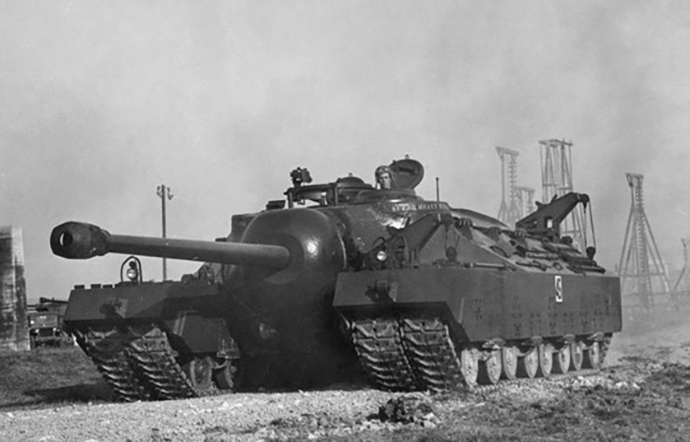
After conversations the previous year, Allied war planners agreed to build five break through tanks for the Siegfried line. Final design plans were submitted in March of 1945 and by August of that year, the first hull had been completed. The design chosen was not for a true tank but rather an assault gun with a fixed casemate boasting a 105mm gun, capable of engaging fixed reinforced concrete defensive structures and German heavy tanks all the same. With armor in its thickest points up to 12 inches, it was even more heavily armored than the Maus, but due to it only having a single main gun, and weighing in at only 95 tons, it only required a crew of four.
|
|
|
|
The T-28 did have a very interesting design feature however. As Allied designers were worried about the concentration of weight in such a small area when it was moving, fearing it would bog down easily, the assault gun was actually designed to have four tracks, two on each side. This would greatly help disperse its weight over a larger surface area on the ground. This would have been crucial in trying to break through defenses where purposely mudding grounds to stop tanks had been a tactic the Germans had employed in the past. Finally, as a near standard design feature of any American armored vehicle of the war, it sported a .50 cal heavy machine gun on its roof for anti-aircraft and anti-infantry purposes.
Unfortunately, this tank was no longer needed in Europe nor the Pacific by the war's end. As other heavy tank programs, including those based on the hull of the Pershing tank that was already in larger scale production, were bearing more fruit, the T28 project was officially canceled in 1947. The two examples that had been produced were stored and then lost by the US Army until one was found in 1974 at Ft. Belvoir, where it was covered in overgrowth in an abandoned field. Afterwards it was moved to the United States Army Armor and Cavalry Collection where it lies to this day.
|
|

|
|
Now, these beasts are no longer just paper and prototype designs that never saw combat. These two giants, along with an entire new range of other tanks, armored vehicles, and support units are coming to Late War with Late War: Leviathans where you can finally see how these units would fare in the combat they were designed for.
|
|
~ Kyle
|
Last Updated On Wednesday, October 9, 2024 by Kevin
|
|