|
|
|
|
Products mentioned in this Article
--None--
|
|
|
|
|
|
|
|
|
 |
|
|
 |
Japanese Tanks in The Pacific
By Jacob Hopkins
Japanese armour development lagged behind that of the major Allied powers throughout the Pacific War. Their tank design philosophy, influenced by the Sino-Japanese War and logistical constraints in Asia, prioritized light and medium tanks focused on infantry support rather than direct tank-on-tank engagements.
|
|
Imperial Army tanks, primarily the Type 95 Ha-Go (light) and Type 97 Chi-Ha (medium), saw initial success in the rapid conquest of Southeast Asia and the Philippines. Their speed and maneuverability in jungle terrain surprising Allied forces who often underestimated the use of armour in such environments. While effective against the lightly armed Allied forces initially encountered, their thin armour and low-velocity guns made them increasingly vulnerable as the war progressed and the Allies deployed more modern tanks and anti-tank weaponry.
As the Allied counter-offensive gained momentum, the limitations of Japanese armour became starkly apparent. Encounters with US M3 Stuarts and later M4 Shermans revealed the inferior firepower and protection of most Japanese tanks. While some improved designs like the Shinhoto Chi-Ha (with a higher-velocity 47mm gun) and the Type 1 Chi-He (with welded armour and which were relegated to home island defence) were introduced, production numbers remained low due to Japan's industrial capacity being focused on naval and aircraft production. An issue that would frustrate Japanese ground forces through to the end of the war.
The IJA primarily organized its armour into tank divisions. There were four main tank divisions formed during the war:
-1st Tank Division: Initially stationed in Manchuria, elements were deployed to Saipan (9th Tank Regiment), while the rest participated in Operation Ichi-Go in China and later redeployed to the Japanese home islands for defense.
-2nd Tank Division: Played a significant role in the conquest of the Philippines and later saw action in Luzon against the US landings in 1944-1945, where it was largely destroyed.
-3rd Tank Division: Primarily deployed in China for much of the war, including the major Operation Ichi-Go offensive in 1944.
-4th Tank Division: Formed later in the war and mainly stationed in the Japanese home islands in preparation for the anticipated Allied invasion.
Numerous independent tank regiments were formed and deployed throughout Southeast Asia and the Pacific. These were often attached to infantry divisions to provide mobile fire support. Some notable deployments include:
-1st, 6th, and 14th Tank Regiments: Played a crucial role in the Malayan Campaign, demonstrating the effectiveness of tanks in terrain initially deemed unsuitable by the British.
-4th and 7th Tank Regiments: Involved in the invasion of the Philippines in 1941-1942, engaging in some of the earliest tank-on-tank battles of the Pacific War against US M3 Stuarts.
-9th Tank Regiment: Deployed to Saipan and Guam, where it faced US Marine M4 Shermans and was largely destroyed in the intense fighting.
At first, Japanese tankers were known to be more aggressive on the attack than their counterparts in the infantry, often racing out ahead of their accompanying troops. This would lead to the tankers having to dismount and clear obstacles themselves rather than waiting for the engineers. In addition, the accuracy of their tank guns was often low, despite training emphasis on accuracy and hitting a target with the first shot, this would lead to relying on either mass fire or fireing on the move to saturate enemy targets. As the war progressed however, they often began to rely on ambush and hull-down positions to compensate for their comparatively thin armour, utilizing the terrain to maximize their limited firepower and minimize return exposure.
|
|
Type 97 Chi-Ha (Medium Tank)
The most widely produced Japanese tank of WWII. Early versions had a low-velocity 57mm gun primarily for infantry support. Later versions (Shinhoto Chi-Ha) received a higher-velocity 47mm gun with better anti-tank capabilities.
|
|

|
| In Flames Of War the base Chi-Ha brings a decent chassis with front armour 3, side armour 2 and top armour 1, while the overworked 57mm gun has only anti-tank rating of 5. However, it does have firepower 3+ which will be of great use against fighting enemy infantry. The Shinhoto upgrade brings a better 47mm gun with AT8, and firepower 4+, but still overworked and with no HE. |
 |
 |
|
Type 98 Chi-Ro (Medium Tank)
An older and very outclassed design that saw service throughout the war despite officially beginning to be withdrawn in 1942. It's noticeably slower than the Type 97, only has front and side armour of 1, but top armour 2, and has the same low velocity 57mm as the Chi-Ro. What this tank does have going for it is that it is cheap, and you can take 17 in a formation for 17 points. Infantry without dedicated anti-tank weapons will struggle to fight them as they slowly grind their way up the field.
|
|
|
|
Type 95 Ha-Go (Light Tank)
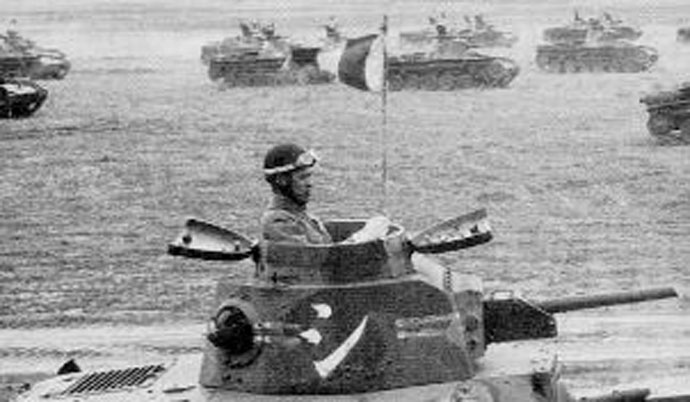
A common early and mid-war light tank. It packs the engine of the Type 89 into a smaller and lighter chassis, granting it maneuverability similar to the Type 97. However, it has armour 1 on all sides, and its 37mm gun, while having AT6, is let down by being overworked yet again, a recurring theme in Japanese tank design. However, again super cheap, being 1 point per tank, you can pack a lot of these in a 100 point game.
|
|
|
|
The above three tanks all feature in their own bespoke Formation, with an HQ and two to three platoons of each tank being taken. The fourth platoon option in all three Formations allows for a choice between the Type 97 Te-Ke of Type 94 TK Recon tankettes.
|
|
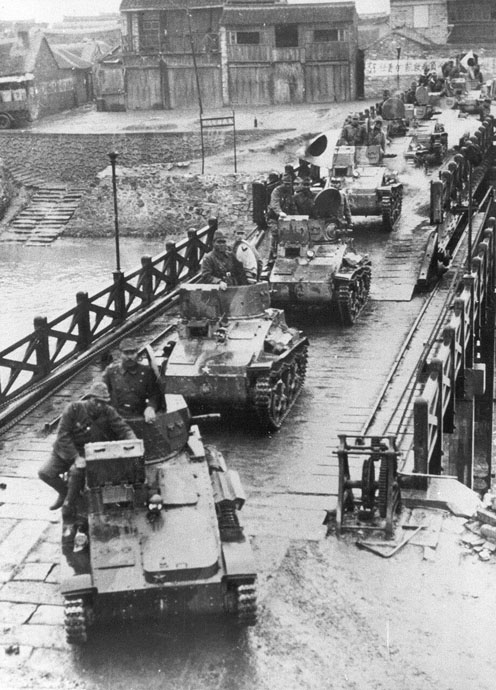
Type 94 TK (Tankette)
A very light and fast vehicle primarily intended for reconnaissance and infantry support. Its armament and armor are minimal featuring all around armour of 1 and a single MG in its turret. However, it comes in at less then a point per tank and is an excellent way to access the Spearhead rule.
|
|
|
|
Type 97 Te-Ke (Tankette)
Designed as a replacement to the Type 94 in 1937 and based off lessons gained in China and against the Soviet Union. The Type 97 turret could be armed either with the 37mm from the Type 95 Ha-Go or a machine gun, and featured slightly higher front armour 2. In game terms the 37mm is bought as a single point upgrade to the base tankette and replaces the MG, and also has the Spearhead rule.
|
 |
|
Type 2 Ka-Mi (Amphibious Tank)
Designed for amphibious landings by the Japanese Navy and arguably the best amphibious tank of the second world war. It would first see combat during the Guadalcanal campaign in late 1942, supporting SNLF landing operations. The Type 2 Ka-Mi was partially based on the Type 95 Ha-Go. Amphibious operation carried out with the help of detachable pontoons on both front and rear of the tank, with towers covering both the engine deck and turret to prevent swamping. In game terms you have a slightly more expensive but amphibious Ha-go, with better halted ROF and a higher anti tank of 7 on its 37mm.
|
|

|
|
Wildcards
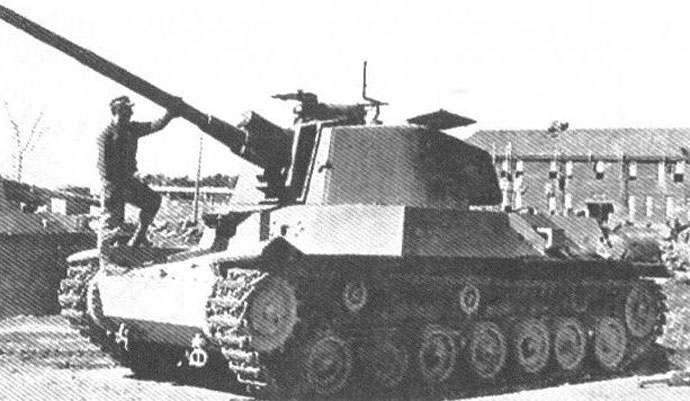
Type 4 Chi-To (Medium Tank)
Designed in 1943, the Type 4 is a continuation of the Type 97 Shinhoto Chi-Ha with increased armor and a longer 75mm gun, it was meant to be the answer to the American Sherman. Production was delayed due to steel shortages as what was available would mostly be allocated to naval production, with only 2 examples leaving the line but never seeing combat. In game terms the Type 4 is a fantastic beast. Front Armour 7, side 3 and top 1, with great speed and a cross of 3+. Carrying along in its spacious turret is a 75mm gun with AT 12, firepower 3+ and no overworked, this machine will truly beat the allies into submission.
|
|
|
|
Wildcards
Type 1 Ho-Ni (Self-Propelled Gun)
A Chi-Ha chassis mounting the 75mm Type 90 field gun, similar to a German Marder, the Type 1 Ho-Ni was a valuable self-propelled gun in an army low in mechanisation. While the Type 1 did actually see combat service in the Philippines, this was not until 1945, despite first beginning production in 1942. However if the Navy had not forced the allocation of so much of the Japanese industrial base to ships, it's possible this could have entered service far sooner. In Flames Of War we get a great SPG with front armour 5, side 4 and top 0, again having excellent speed and cross check 3+. The 75mm can fire either bombardments up to 80” with standard AT 2 and firepower 4+, or smoke bombardments. Alternatively you can use it to engage in a direct fire role where its antitank 10 and firepower 3+ will make short work of most of the allied fighting vehicles it will face.
|
|

|
|
Wildcards
Panzerkampfwagen VI Tiger (Heavy Tank)
In 1943, Japan placed an order for a Tiger 1, to be shipped via submarine and then reassembled in Japan for study and development. By the time that payment was delivered, delivery was unrealistic at best and as such the purchase was loaned back to the German army and the Tiger was allocated to the 101st SS Heavy Panzer Battalion. In game terms you get a single Tige 1, with standard Front 9, side 8 and top 2. The fearsome 88 bringing its anti tank 14 and firepower 3+ to terrorize the jungles of The Pacific.
|
|

|
|
All of the Japanese tanks detailed above feature the Duty to the End special rule. This allows bailed out Japanese tanks to shoot MGs in defensive fire as well as to roll to hit in Assaults if in contact. They cannot move to counterattack or break off however. Also, a bailed out tank will prevent enemy units from winning an assault when you check for remaining teams, but if the unit is forced to break off, all bailed out tanks are still destroyed. This will be hugely helpful as you will often want to close with and assault enemy infantry to make the most of your tank forces.
Be like your historical counterpart and channel the aggressive spirit of the IJA, close quickly and drive for the flanks to fight Shermans, Valentines or Grants. Make use of cover and concealment in order to outmaneuver your foe and keep them on the back foot, and remember that even in the face of superior firepower, courage and determination can often turn the tide of battle. Good luck, and Tenno Heika Banzai!
~ Jacob, Lack of Foresight Gaming
|
Last Updated On Thursday, May 22, 2025 by Kevin
|
|
|