|
|
|
|
Products mentioned in this Article
--None--
|
|
|
|
|
|
|
|
|
 |
|
|
 |
The Pacific, 1942 - 1943 Spotlight
Australian Forces
with Wayne Turner
The Pacific expands the Flames Of War Mid-war period into an entirely new theatre. It covers the forces and battles that take part in the first half of the war in Asia and the Pacific from Japanese surprise attacks in December 1941 to the island and jungle campaigns of 1942 and 1943. Battles are fought far and wide across the theatre, from the plantations and fields of Malaya, the cities of Singapore and Rangoon, through the mountains and jungles of New Guinea, Burma, and the Island of Guadalcanal and the rest of the Solomon Islands to the isolated islands of the Marshall and Gilbert groups.
Order the book on the Battlefront Group webstore...
|
|
To cover these extensive campaigns The Pacific features Forces, Formations, and Units of the Imperial Japanese Forces, US Marine Corps and US Army Forces, British and Indian Forces, and Australian Forces.
The Pacific also contains rules and guides for Pacific and Asian terrains, Missions and rules for amphibious assaults, jungle fighting, and island fortifications.
|
|
Includes Free Forces Code
As a bonus for purchasing The Pacific, 1942 - 1943 you will also find in the back of the book a FREE code to redeem all the forces and command cards contained within the book for use in Forces Of War.
Forces Of War is the online force builder for Flames Of War and is an invaluable tool for building and storing army lists, as well as printing out Unit and Command Cards ready for battle.
Includes Free PDF Download
In addition to being able to access Forces with this code, you can also use it on the Battlefront Digital website to unlock a free PDF download of the book to you computer or tablet!
Includes Free Catalogue
With each copy of The Pacific, 1942 - 1943 you will find a copy of the full catalogue, detailing all the Flames Of War miniatures and accessories found in the Pacific book. Use this as a point of reference to get to know your opponent's potential army composition or to help plan the next additions to your own army.
|

|
|
 |
|
While fighting in North Africa Australian forces were engage alongside the British and other commonwealth forces against the Germans and Italians. However, back on home territory they had different priorities to those of British and Indians, concentrating on defending their own territory from the rapid Japanese expansion. Some Australian forces saw action in Malaya and Singapore, but the bulk of Australia’s fighting in 1942 and 1943 was in Papua New Guinea, at that time an Australian administered territory.
The Australian have their own set of National Special Rules, some are familiar from British forces like Mike Target (for artillery) and Deadly (for infantry). They also have Determined (improving their Rally rating), and Canister (for 37mm tank guns). The Commandos also have additional rules (see below).
The Pacific features a separate Australian Forces with six Formations. Three infantry formations, and three armoured formations.
|
 |
|
Australian Infantry
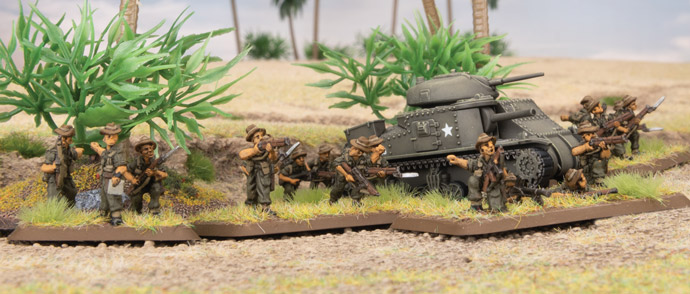
The first of the Australian formations is the Rifle Company, representing the veterans returning from North Africa. These units are rated Confident 4+, Veteran 3+, Careful Is Hit On 4+, but they also gain all the rating benefits from the Determined and Deadly special rules.
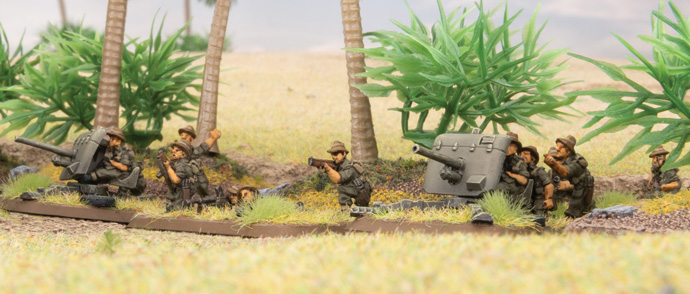
They are organised in a similar manner to British rifle companies with compulsory unit of an HQ and two to three Rifle Platoons. They can have a 3-inch Mortar Platoon, one or to Vickers MMG Platoons, a 2 pdr Anti-tank Platoon, and up to four Universal Carrier Patrols. In addition, one Recon box can be taken as a Dismounted Carrier Platoon.
The Rifle Platoon, like the British, are made up of five to seven Bren Gun & SMLE rifle team, with an optional Boys anti-tank rifle and a 2-inch mortar.
The 3-inch Mortar Platoon provides two or four 3-inch mortars for indirect artillery fire and a smoke bombardment for masking the company’s movement.
The two Vickers MMG Platoons add additional direct and indirect fire support.
The 2 pdr Anti-tank Platoon, with is two to four 2 pdr anti-tank guns, provided defence against Japanese tanks.
|
 |
|
On the Papua New Guinea coastal planes the Universal Carrier Patrol provide excellent reconnaissance, as well as some additional firepower when required. When fighting in the mountainous jungles the patrols would dismount and fight as foot scouts, this represented by the Dismounted Carrier Platoon, a unit with the Spearhead and Scout rules and made up of five to nine Bren Gun teams. Like the carriers, they also have an option for a Boys anti-tank rifle.
Before the bulk of the returning veteran arrived in theatre, the Militia (Citizen Military Force or CMF) had been sent to Papua New Guinea to hold off the initial Japanese encroachments. These Militia Rifle Companies are organised like their veteran comrades, but are less experienced. They are rated Confident 4+, Trained 4+, Aggressive Is Hit On 3+, but they also gain all the rating benefits from the Determined and Deadly special rules.
The key difference in their organisation is that they don’t have the Dismounted Carrier Platoon option.
Australian Commandos
The third Australian infantry formation is the Commando Independent Company. In 1940, the Australian Army began considering the issue of raising commando units or independent companies for the conduct of irregular warfare. The first of these units were the independent companies, of which twelve were formally raised. The first commando unit to see action was the 1st Independent Company defending the island of New Ireland (part of the Australian territory of Papua New Guinea), from Japanese Naval Infantry in early 1942. Other companies served with considerable distinction in other parts of Papua New Guinea and the Dutch East Indies, mainly performing roles such as long-range reconnaissance, intelligence gathering and flank protection, but also occasionally being called upon to perform more traditional infantry roles.
As befits their specialised training and role the Commandos have their own special rules and ratings. They all use the Mountaineers and Deadly special rules. They are rated Fearless 3+, Veteran 3+, Careful Is Hit On 4+, with the benefit of Deadly Assault 2+. A company is quite a large organisation with an HQ and two to eight Commando Sections, and a Commando Scout Section.
However, a Commando Section is a small unit of just five Bren Gun & SMLE rifle teams. It can also add an optional Boys anti-tank rifle team, a 2-inch mortar team, as well as replacing two Bren Gun & SMLE rifle teams with Own SMG teams, as a further one with a Flame-thrower team.
The Commando Scout Section is similar, but with three to five Bren Gun & SMLE rifle teams and only the option to swap for Owen SMG teams. In addition, they have the Scout and Spearhead rules.
|
 |
|
Australian Armour
The Australian section also contains three armoured formations. Though most of the initial fighting was in the mountains of Papua New Guinea, the Australian raised a substantial armoured force due to the real concern that the Japanese may attempt to land in northern Australian.
The Australian armoured forces are rated Confident 4+, Trained 4+, Careful Is Hit On 4+.
The first of these Australian based formations is the Grant Armoured Squadron. These squadrons were organised with an HQ or two or three Grant tanks, and two to three Grant Tank Troops with three tanks in a similar fashion to the British. One of Tank Troops can be instead armed M3 Stuart tanks.
The M3 Grant tank have the larger turret armed with an American 37mm gun just as the British ones are. In the hull is a 75mm gun offering more anti-tank and destructive power. The Grant utilises the Secondary Weapon rule for the 37mm gun, allowing it to fire at ROF 1 at the same time as the 75mm gun. However, if they do this, the Secondary Weapon suffers a +1 penalty to hit. Both the 37mm and 75mm guns may fire different targets. The Grant is quite well-armoured, especially in the context of the Pacific against Japanese tanks and guns.
The second armoured formation is the Stuart Armoured Squadron. This formation has an HQ and two to four Tank Troops. Each has three Stuart light tanks. These light and fast tanks served in Australia, as well as being sent to support the troops fighting in Papua New Guinea.
|
 |
|
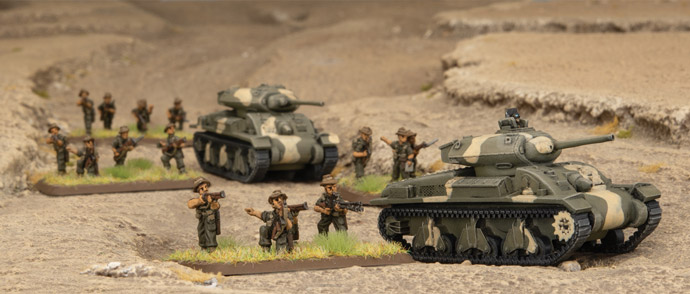
The final armoured formation features Australia own indigenous tank design, the Sentinel. The design of the Australian AC1 Sentinel Cruiser Tank began in late 1940 when it was uncertain whether a supply of armoured vehicles would be available from the United Kingdom. The brief was for a tank using only readily available materials and sources in Australia. By September 1941 a design was completed, with the first prototype being constructed in January 1942. The result was something that looked like a hybrid between a US M3 Lee and a British Crusader. They were never needed in combat, but they were used for training in Australia.
The Sentinel was quite well-armoured (Front 6, Side 5, To 1) and was initially armed with the standard tanks weapon at the time, the 2 pdr. However, provision had been made to mount the 6 pdr when it became available. Some were even fitted with Australia’s own shortened version of the 25 pdr field gun. It was additionally armed with a hull MG and a co-ax MG in the 2 pdr armed version, but only the hull MG in 6 pdr and 25 pdr armed variants.
A Sentinel Armoured Squadron has an HQ of two to three Sentinel (2 pdr), and two to three Armoured Troops. These could be either troops of 2 pdr armed, 6 pdr armed, or mixed of two Sentinel (6 pdr) and one Sentinel (25 pdr).
|
|
Australian Support
The Australian forces have a selection of Support Unit that includes aircraft, artillery, and anti-aircraft.
The release of The Pacific will also see the release of all the appropriate models for the above Australian forces. The book come bundled with a separate comprehensive catalogue showing all the models and what to buy.
|
Last Updated On Thursday, April 24, 2025 by Chris at Battlefront
|
|
|