|
|
|
|
Products mentioned in this Article
--None--
|
|
|
|
|
|
|
|
|
 |
|
|
 |
The Pacific, 1942 - 1943 Spotlight
British and Indian Forces
with Wayne Turner
The Pacific expands the Flames Of War Mid-war period into an entirely new theatre. It covers the forces and battles that take part in the first half of the war in Asia and the Pacific from Japanese surprise attacks in December 1941 to the island and jungle campaigns of 1942 and 1943. Battles are fought far and wide across the theatre, from the plantations and fields of Malaya, the cities of Singapore and Rangoon, through the mountains and jungles of New Guinea, Burma, and the Island of Guadalcanal and the rest of the Solomon Islands to the isolated islands of the Marshall and Gilbert groups.
Order the book on the Battlefront Group webstore...
|
|
To cover these extensive campaigns The Pacific features Forces, Formations, and Units of the Imperial Japanese Forces, US Marine Corps and US Army Forces, British and Indian Forces, and Australian Forces.
The Pacific also contains rules and guides for Pacific and Asian terrains, Missions and rules for amphibious assaults, jungle fighting, and island fortifications.
|
|
Includes Free Forces Code
As a bonus for purchasing The Pacific, 1942 - 1943 you will also find in the back of the book a FREE code to redeem all the forces and command cards contained within the book for use in Forces Of War.
Forces Of War is the online force builder for Flames Of War and is an invaluable tool for building and storing army lists, as well as printing out Unit and Command Cards ready for battle.
Includes Free PDF Download
In addition to being able to access Forces with this code, you can also use it on the Battlefront Digital website to unlock a free PDF download of the book to you computer or tablet!
Includes Free Catalogue
With each copy of The Pacific, 1942 - 1943 you will find a copy of the full catalogue, detailing all the Flames Of War miniatures and accessories found in the Pacific book. Use this as a point of reference to get to know your opponent's potential army composition or to help plan the next additions to your own army.
|

|
|
 |
|
Britain far eastern forces in Malaya, Burma, and India were mostly made up of Indian troops, with a few European units, as well as troops from Burma and other far-flung part of the British Empire. From December 1941 until the end of 1943, they saw fighting in Malaya, Singapore, Burma and on the eastern fringes of India.
The British and Indians follow many of the standard British special rules, such as Mike Target (for artillery), Bulldog and Deadly (for infantry). However, the Indians have a unique rule of their own, War Cry. Indians always charge shouting war cries to gain the blessings of the gods and intimidate their enemies. Weak-hearted foes hearing this fearsome cry will flee without a fight. Enemy Units must re-roll their first successful Motivation Test to Counterattack a Unit with War Cry.
British troops are usually rated Confident 4+, Green 5+, Aggressive Is Hit On 3+, but they also gain all the rating benefits from the Bulldog and Deadly special rules.
Indian troops are usually rated Fearless 3+, Green 5+, Aggressive Is Hit On 3+, but they also gain all the rating benefits from the Deadly special rule.
The British and Indian forces represented in The Pacific consist of two infantry formations and two tank formations.
|
 |
|
British Infantry
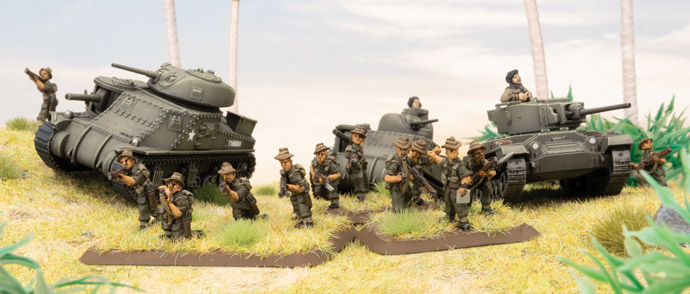
The first formation is the British Rifle Company. Many British battalions fought as part of Indian Army divisions and brigades. For example, the 46th Indian Brigade had attached the 2nd Battalion, King's Own Yorkshire Light Infantry and 2nd Battalion, Duke of Wellington's Regiment who fought alongside its Indian, Gurka, and Burmese rifle battalions during February 1942. A Rifle Company is a formation built around an HQ and two or three Rifle Platoons. Added to that is a 3-inch Mortar Platoon, a Vickers MMG Platoon, one or two 2 pdr or 6 pdr Anti-tank Platoons, and up to four Universal Carrier Patrols.
A Rifle Platoon has five to seven Bren Gun & SMLE rifle teams. You can add a Boys anti-tank rifle and a 2-inch mortar for additional firepower.
Both the 3-inch Mortar Platoon and Vickers MMG Platoon can provide indirect artillery fire, while the Vickers MMGs can also provide a high rate of direct fire.
Initially the 2 pdr anti-tank gun was the main anti-tank weapon available, but by 1943 6 pdrs were beginning to arrive in theatre. However, against most Japanese tanks encountered in Malaya and Burma the 2 pdr was more that enough (AT 7, FP 4+, No HE). When the 6 pdr did arrive, it was ensured that it had a HE round. This proved useful with the 6 pdr (AT 9, FP 4+) being used in the dual role of anti-tank and infantry gun.
Reconnaissance is provided by the Universal Carrier Patrols, where the fully tracked carrier was especially useful cross paddy fields and wooded terrain where jeeps, trucks, and wheel armoured car had trouble.
|
 |
|
Indian Infantry
An Indian Rifle Company is organised much the same but with few key differences. There anti-tank platoons came from the same sources as the British units, so utilise the same units. They also have an additional carrier option, where three of their carrier patrols can be wheeled Indian Pattern Carriers. The Indian Pattern Carrier is a simple armoured scout car built on 15 cwt Ford or GMC CMP (Canadian Military Pattern) trucks with a simple armoured body. It was never intended as a replacement for the Bren Carrier, but it was pressed into this role, among many others, when the British units got priority on tracked carriers. Its Terrain and Cross-country dash moves are not as good as the Universal Carrier, but on road it out paces the track carrier substantially.
British and Indian Armour
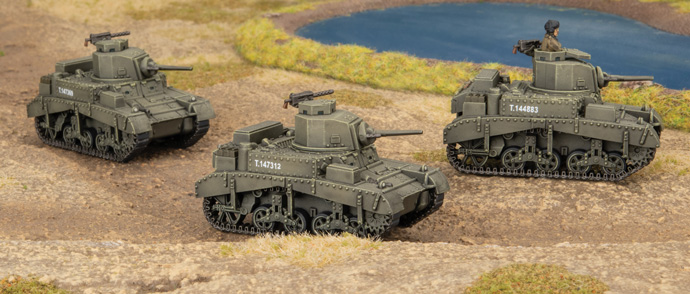
The first of the armoured formations is the Honey Armoured Squadron. These are the desert veteran of 7th Armoured Brigade. They were shipped to far east to reinforce Singapore, but when the city fell before, they arrived they were diverted to Burma. Their rating a different from the other British troops, with Confident 4+, Trained 4+, and Careful Is Hit On 4+. They have the same Honey tanks they used in the desert with armour enough to stand up to lighter Japanese weapons (Front 3, Side 2, Top 1), and a useful 37mm gun (AT 7, FP 4+, No HE, Overworked). The formation is a simple squadron of an HQ with two to four Honey Armoured Troops. Each Troop had three Honey tanks.
In 1943 the Indian 25th Dragoon when into action with the first Grant and Lee tanks to see action in Burma. Initially, these were surplus tanks shipped from North Africa. Both variants of the US M3 Medium tank were used, the Grant and Lee. Because the British removed the machine-gun from the Cupola of their Lees, the two types become functionally the same. This means you can model how you like, mixing the type together or dividing them into separate Troops.
Both have good armour (Front 5, Side 4, Top 1) and two useful guns, a 37mm (AT 7, FP 4+) in the turret and a 75mm (AT 9, FP 3+) gun in the hull. Because of this the Grants and Lees use the Secondary weapon rule on the 37mm gun.
Like the Honeys, the Grant/Lees are organised in a Squadron of an HQ and two to four Grant/Lee Armoured Troops of three tank each.
|
 |
|
Wildcard and Support
The British also get a Wildcard unit, the T18 Boarhound. In July 1941 the US Army Ordnance office issued joint specifications with the British for three new armoured cars. The T18 heavy armoured car was one of the results. It is a large all-wheel-drive, eight-wheeler. Its thick armour was unusual for an armoured car, but made the vehicle three times the weight of the equivalent German eight-wheeled armoured cars. It was heavily armed with a M1 57mm gun, a US variant of the British 6 pdr gun. The British ordered for 2500 T18E2 armoured cars, which they promptly christened the Boarhound. High production costs led to cancellation of the initial order after only 30 were delivered. If these 30 vehicles had been shipped to India, they would have supported the lighter armoured cars. The Boarhound’s eight-wheeled design would have been great over the rough roads of Burma, but the jungle, like with any vehicles, would have been more of a problem.
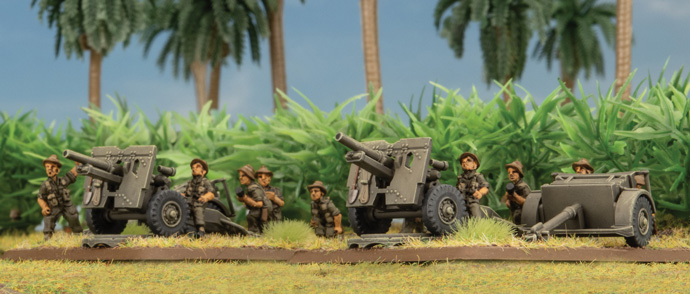
The British and Indian formations can call on a variety of Support Units. These include artillery, armoured cars, tanks, anti-aircraft, and aircraft.
The release of The Pacific will also see the release of all the appropriate models for the above British and Indian forces. The book come bundled with a separate comprehensive catalogue showing all the models and what to buy.
|
 |
Last Updated On Thursday, April 24, 2025 by Chris at Battlefront
|
|
|