|
|
The Pacific - Imperial Japanese Forces Spotlight
 |
The Pacific, 1942 - 1943 Spotlight
Japanese Forces
with Wayne Turner
The Pacific expands the Flames Of War Mid-war period into an entirely new theatre. It covers the forces and battles that take part in the first half of the war in Asia and the Pacific from Japanese surprise attacks in December 1941 to the island and jungle campaigns of 1942 and 1943. Battles are fought far and wide across the theatre, from the plantations and fields of Malaya, the cities of Singapore and Rangoon, through the mountains and jungles of New Guinea, Burma, and the Island of Guadalcanal and the rest of the Solomon Islands to the isolated islands of the Marshall and Gilbert groups.
Order the book on the Battlefront Group webstore...
|
|
To cover these extensive campaigns The Pacific features Forces, Formations, and Units of the Imperial Japanese Forces, US Marine Corps and US Army Forces, British and Indian Forces, and Australian Forces.
The Pacific also contains rules and guides for Pacific and Asian terrains, Missions and rules for amphibious assaults, jungle fighting, and island fortifications.
|
|
Includes Free Forces Code
As a bonus for purchasing The Pacific, 1942 - 1943 you will also find in the back of the book a FREE code to redeem all the forces and command cards contained within the book for use in Forces Of War.
Forces Of War is the online force builder for Flames Of War and is an invaluable tool for building and storing army lists, as well as printing out Unit and Command Cards ready for battle.
Includes Free PDF Download
In addition to being able to access Forces with this code, you can also use it on the Battlefront Digital website to unlock a free PDF download of the book to you computer or tablet!
Includes Free Catalogue
With each copy of The Pacific, 1942 - 1943 you will find a copy of the full catalogue, detailing all the Flames Of War miniatures and accessories found in the Pacific book. Use this as a point of reference to get to know your opponent's potential army composition or to help plan the next additions to your own army.
|

|
|
 |
|
The Pacific allows you to field Forces from both the Imperial Japanese Army as well as the Japanese Imperial Navy special landing forces.
The Japanese have a flavourful selection of National Special Rules to cover their unique fighting style and ethos. The Banzai gives Japanese infantry a number improved abilities in Assaults. They get a 6”/15cm Charge into Contact move, better Counterattack and Assault ratings, and are never forced to Fall Back from Defensive Fire. However, this comes at a cost, they only Save on 4+ (instead of 3+) against Defensive Fire. They also cannot choose to Break Off from and Assault (so only do so if they fail a Counterattack roll).
The Jungle Craft rule give Japanese Army Infantry teams a12”/30cm Terrain Dash (instead of 8’/20cm).
The No Surender rule gives Units a better Last Stand rating.
The Night Attack rule allows Some Japanese formations to take advantage of the cover of darkness at the start of a game if they are the Attack in missions with Minefields.
The Duty to the End rule makes Japanese tanks dangerous even when Bailed Out. Bailed Out Japanese tanks can shoot their MGs in Defensive Fire and can roll to Hit in Assaults if contacted by enemy teams, but they still can’t move to Charge into Contact in a counterattack or to Break Off. A Bailed-Out tank can also prevent enemy units winning in an Assault when check to see if the Assault if over. However, it their unit Breaks Off, Bailed Out tanks are still destroyed.
The final unique Japanese rule is the Fire Bursts rule for some artillery units. A Unit with Fire Bursts firing an Artillery Bombardment only re-rolls successful Hits if it has only one weapon firing (instead of the normal 1 or 2 weapons).
Japanese Army Units are usually rated Confident 4+, Trained 4+, Aggressive Is Hit On 3+, but they also gain all the rating benefits from the Banzai and No Surrender special rules.
|
 |
|
Japanese Armoured Formations
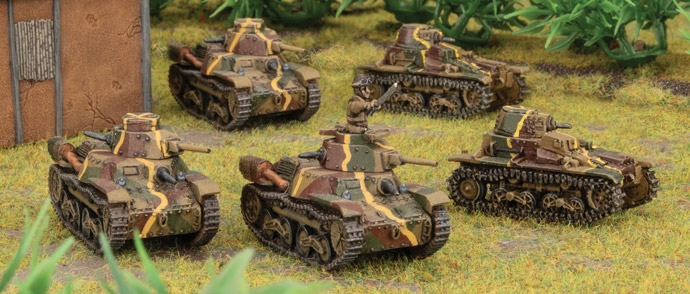
The Japanese section included three army armoured formations. The first of these is the Type 97 Chi-Ha Tank Company. The Type 97 Chi-Ha medium tank, first deployed in 1937, was the mainstay of Japan’s medium tank forces. Initially it mounted a low velocity 57mm gun (AT 5, FP 3+). The limitations of this gun became apparent in action against the Soviets at Nomonhan in 1939, and as a result the Japanese developed a new 47mm gun (AT 8, FP 4+) to provide the punch necessary to penetrate modern armour, called the Type 97 Kai Shinhoto Chi-Ha. The formation allows you to field any mix of both types in an HQ of two tanks and two or three platoons of three to five Type 97 Chi-Ha tanks.
In addition, the formation can also field Recon Tankette Platoon of either the Type 97 Te-Ke or the Type 94 TK, both being light tankettes. The Type 97 Te-Ke can either be either armed with a MG or a 37mm gun, or as a mix of weapons in the Unit. The Type 94 TK is solely armed with a MG.
|
 |
|
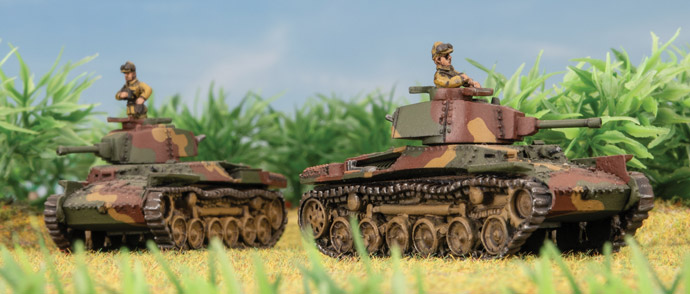
The second army armoured formation is the Type 89 Chi-Ro Tank Company. This formation is organised the same way as the Type 97 Chi-Ha company, but is armed with the Type 89 Chi-Ro medium tank. The older Type 89 medium tank went into production in 1931, and it served as Japan’s primary battle tank during the 1930s. The Type 89 mounted a low velocity 57mm gun (AT 5, FP 3+), but its armour was thin (Front 1, Side 1). However, when facing infantry forces the Type 89 shines with its two machine-guns (ROF 4/4), the 57mm gun’s good 3+ firepower, and its excellent 2 top armour they make good support tanks, just be weary of enemy anti-tank guns.
The third Japanese army armoured formation is the Type 95 Ha-Go Light Tank Company. The Type 95 Ha-Go was, by the standards of the mid 1930s, an excellent light tank. Using the same diesel engine as the Type 89 in a much lighter tank afforded the vehicle far greater performance than its older cousin. Its only major drawback was the fact that its 37mm gun was housed in a one-man turret (this gives it the Overworked rule, giving it a +1 To Hit when moving). Like the previous formations it is made up of an HQ, and two or three Units and a Recon Tankette Platoon.
Japanese Infantry
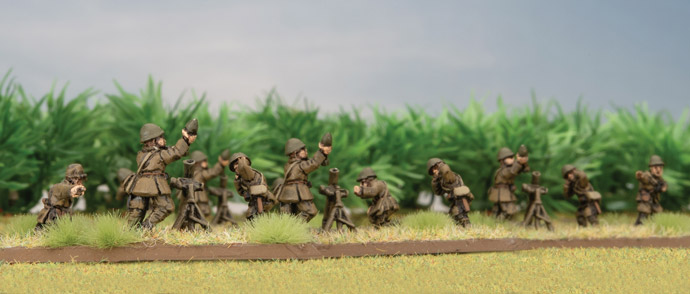
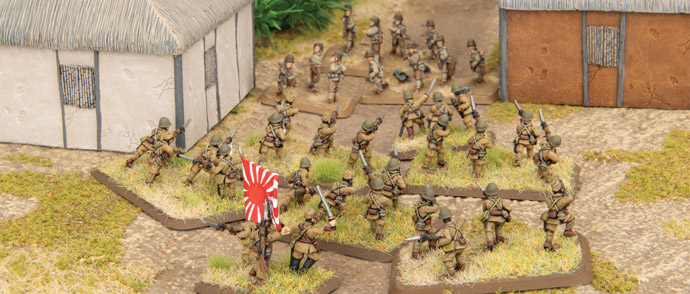
The vast majority of the Japanese fighting men in the Pacific and Asia were organised into infantry formations, specifically Infantry Companies. The Japanese rifleman has had a focused training regime that emphasises the spiritual aspects of fighting, such as certainty in victory, loyalty, and patriotic duty. The spirit of the offensive is instilled in every soldier, and tactical training concentrates on infantry combat and hand-to-hand fighting. The Infantry Company Formation has a compulsory core of an HQ with two Type 38 rifle team, and two or three Infantry Platoon with seven to ten Type 38 rifle teams and two or three Type 89 50mm mortars. To this basis of rifle teams and light mortar teams, an Infantry Platoon can add an HMG team, a 20mm anti-tank rifle, and an additional 50mm mortar.
|
 |
|
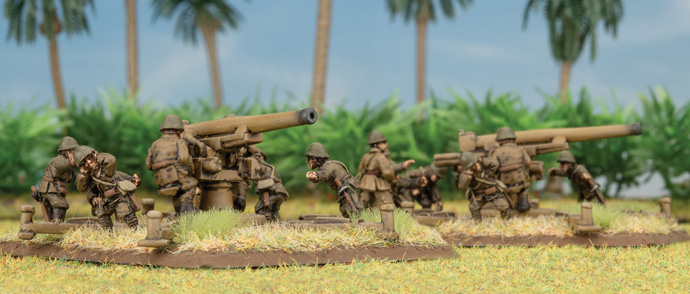
The formation also includes options to take a machine-gun platoon, a Rapid-fire Gun Platoon (with two 37mm or 47mm anti-tank guns), a 70mm Battalion Gun Platoon (a pair of guns capable firing bombardment or directly), and a 75mm Regimental Gun Platoon (another pair of more powerful guns capable of bombardment and direct fire).
The other major land fighting component of the Japanese forces are the Imperial Navy’s Special Naval Landing Forces (SNLF). You can find two formations for these forces in The Pacific, one tank and one infantry.
Japanese Naval Units are usually rated Fearless 3+, Trained 4+, Aggressive Is Hit On 3+, but they also gain all the rating benefits from the Banzai and No Surrender special rules.
The Type 2 Ka-Mi Naval Tank Company features a formation of amphibious tanks with an HQ and two or three Units. The Japanese Navy recognised the need for armoured support for their Special Naval Landing Forces, and while the Army’s Type 95 Ha-Go sufficed once the forces had landed, the Type 95 required landing craft or transports. The Navy therefore developed the Type 2 Ka-Mi amphibious tank to support the SNLF during actual landing operations and these were formed into a number of Amphibious Tank Companies. The Type 2 Ka-Mi tank itself was partially based on the Type 95 Ha-Go, sharing suspension components and its 37mm main armament. It has similar armour and land mobility. Its amphibious operations were carried out with the help of detachable pontoons front and rear as well as towers covering both the engine deck and turret to prevent water from entering the tank, so it could be deployed even in high surf conditions.
|
 |
|
The main fighting arm of the SNLF are the men of the Naval Infantry Company. Their formation is similarly organised to their Army counterparts, but with a few additional units included that the Army would normally get from higher level divisional support. A Naval Infantry Company has compulsory troops of an HQ and two to four Naval Infantry Platoon, a Naval Rapid-fire Gun Platoon (37mm or 47mm anti-tank guns), a Naval 81mm Mortar Platoon (2-4 81mm mortars), a Naval 70mm Battalion Gun Platoon, a Naval 75mm Regimental Gun Platoon, a Naval 20mm Anti-aircraft Platoon (2-4 20mm AA guns), and a Naval 75mm Anti-aircraft Platoon (2-4 75mm AA guns). The Naval Infantry Company has a few more gun units inside its formation as its mission was often to take an island in an amphibious assault and then establish its initially defence until further reinforcements arrived.
Japanese Wildcards
The Japanese section also included a number of Wildcard Units. These are either experimental or ‘What if’ units.
The first of these is the Tiger Heavy Tank Platoon. In 1943, Japan bought several examples of German tank designs for study with a view to further development of their own tank designs. A single Tiger I was purchased, along with a Panther and two Panzer IIIs, but only the Panzer IIIs were actually delivered. The undelivered Tiger was loaned to Germany by the Japanese government. However, what if the Tiger had been delivered?
The second Wildcard, the Type 4 Chi-To medium tank, was actually built, but production was delayed due to steel priorities being given to the Navy. The Type 4 Chi-To is the ultimate development of the line of medium tanks started with the Type 97 Chi-Ha. It is longer, wider, taller, better armed, and better armoured (Front 7, Side 3, Top 1) than the Type 97 Chi-Ha and it mounted the long-barrelled Type 5 75mm tank gun (AT 12).
The third Wildcard is the Type 1 Ho-Ni 1 Self-propelled gun. This is a dual role vehicle that could be used as self-propelled artillery or as a tank-hunter. It has good armour (Front 5, Side 4, Top 0) and mounts the 75mm Type 90 field gun (AT 10 direct fire) in an open fighting compartment on a Chi-Ha chassis. The Type 1 Ho-Ni I was intended to be issued to the armoured divisions to fill both the role of mobile anti-tank, as well as self-propelled artillery.
Japanese forces can also call on a useful selection of Support Units, including Engineers, Scouts, Mortars, Artillery, Anti-aircraft, and Aircraft.
The release of The Pacific will also see the release of all the appropriate models for the above Japanese forces. The book come bundled with a separate comprehensive catalogue showing all the models and what to buy.
|
 |
Last Updated On Thursday, April 24, 2025 by Chris at Battlefront
|
|