|
|
|
|
Products mentioned in this Article
--None--
|
|
|
|
|
|
|
|
|
 |
|
|
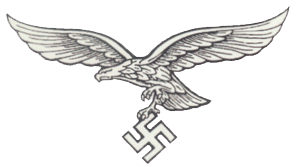 |
16. Luftwaffe Felddivision
The 16. Luftwaffe Felddivision (air force field division) was created in December 1942 with two three-battalion infantry regiments, a Panzerjäger Abteilung (anti-tank battalion), an artillery regiment and a pioneer battalion.
In February 1943 the division was moved to the Netherlands as garrison troops and to man the coastal defences there. Like all other Luftwaffe field divisions, it was taken over by the Wehrmacht (Army) in November 1943. It was then reorganised into a Jäger (light) division with three two-battalion regiments, and a Füsilier battalion was added.
|
|
On 16 June 1944 the division began to move to Normandy from the Netherlands. Initially some elements of the division were left in the Netherlands to man the static defences along the coast, but most of the division was eventually sent to Normandy.
By 1 July the bulk of the Division had detrained in Normandy after first travelling to Paris from the Netherlands by rail. On 2 July the I./ Luftwaffe-Jägerregiment 32 and II/ Luftwaffe-Jägerregiment 46 were committed to the sector defended by the 21. Panzerdivision. The rest of the division were soon arriving in the combat area.
Their first major actions were against British forces during Operation Charnwood on the Orne north of Caen. The division found itself in the thick of the fighting and were badly mauled by the British/Canadian offensive. Their positions were around Point 64, so even before the Allied ground assault began on 7 July the division was battered by bombers, artillery and naval guns. They were then struck by the British 3rd and 59th Divisions.
|
16. Luftwaffe Felddivision
Luftwaffe-Jägerregiment 31
Luftwaffe-Jägerregiment 32
Luftwaffe-Jägerregiment 46
Luftwaffe-Pionier-Bataillon 16
Luftwaffe-Panzerjäger-Abteilung 16
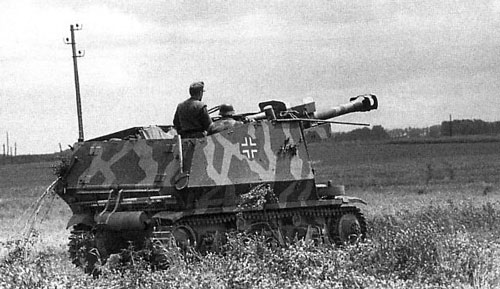
1. Kompanie (5cm PaK38 and 7.5cm PaK40)
2. Kompanie (2 StuG III G)
3. Kompanie (twelve 2cm FlaK38)
Luftwaffe-Artillerie-Regiment 16
1. Batterie (no guns)
2. Batterie (7.62cm FK288(r))
3. Batterie (7.62cm FK288(r))
4. Batterie (7.62cm FK288(r))
5. Batterie (no guns)
6. Batterie (7.62cm FK288(r))
7. Batterie (12.2cm FK396(r))
8. Batterie (12.2cm FK396(r))
9. Batterie (12.2cm FK396(r))
Luftwaffe-Füsilier-Battalion 16 |
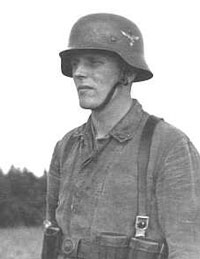 |
An hour after the assault began the two British divisions had captured their initial objectives of Lebisey and Herouville, and were forcing their way through the Luftwaffe positions towards Point 64 and Caen. By 9 July the British had taken Point 64 and, along with their Canadian Allies, the city of Caen.
The 16. Luftwaffe Felddivision took heavy casualties during the fighting, with every battalion commander killed during the bombardment or fighting. The remnants of the division retreated across the Orne and took up positions with the 21. Panzerdivision.
After the fighting the remains of the division spent some time regrouping and refitting, with the remainder of the division’s troops arriving from the Netherlands. It is unclear whether the 16. Luftwaffe Felddivision took their two StuG III G assault guns with them when they relocated to Normandy, but they did receive another eight vehicles on 9 July and these most likely went to the 2. Kompanie of the Panzerjäger Abteilung.
|
| They were involved again in defensive fighting against Operation Goodwood on 18 July. Again the 16. Luftwaffe Felddivision was unlucky enough to bear the brunt of the Allied bombing and artillery preparation. The Luftwaffe troops formed the front line of the 21. Panzerdivision’s sector, with supporting panzertruppen directly behind them in the second line. The Allied forces smashed into the line. Wehrmacht and Waffen-SS troops and tanks held well, but the heavily depleted and shell-shocked Luftwaffe jägers simply couldn’t stand against the superior numbers of the Allies. |
 |
 |
The division never fought again as a unit. Elements continued to fight with the 346. Infanteriedivision and 21. Panzerdivision. Towards the end of July the men from the division were used to replace casualties in the 21. Panzerdivision. The 16. Luftwaffe Felddivision was formally disbanded on 4 August 1944. The remnants of the division were combined with those of the 158. Reserve Infanteriedivision to form the 16. Infanteriedivision in August 1944.
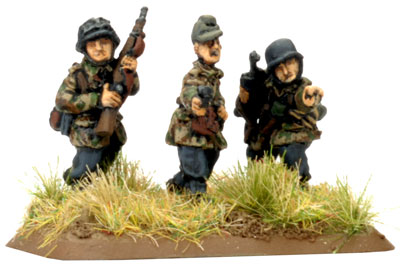
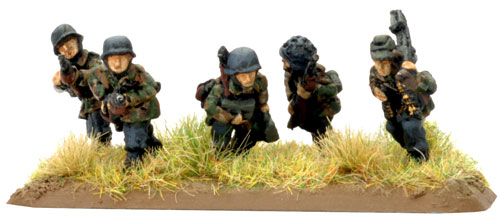
Luftwaffe Field (Jäger) Platoon Product Spotlight...
|
Other Luftwaffe Felddivision in Normandy
The 17. Luftwaffe Felddivision was stationed in Le Harve and remained there on alert until mid August 1944 when it moved with two-thirds of its strength to face advancing US units. It arrived at the front line along the Dure River (near Dreux) on 17 August. They were pushed back to Evreux and during the retreat the division’s command post was captured. However, Generalleutnant Hocker escaped to continue leading the division. The division continued to fight and were forced to withdraw across the Seine River when a US thrust threatened to cut them off from other German units of the 5th Panzer Army. |
 |
 |
They suffered heavy casualties from air attacks during the fighting and by the time they had got across the river the Jägerregiments were down to one battalion each. Fighting continued against the British around Elbeuf, as they crossed the Seine and the British pushed them back beyond Rouen. On 1 September the remnants of the division were combined with the 331. Infanteriedivision.
|
|
The 18. Luftwaffe Felddivision also entered combat in mid-August and moved to the front from their garrison at Dunkirk. They entered the line at Mantes on the Seine on 22 August. They went on the offensive and successfully captured ground from American units, but were exhausted by 25 August. On 27 August, while preparing to retire, they were cut off from their line of retreat by a US attack and were forced to attack with support from Panzer units of the I. SS Panzer Korps.
They took heavy casualties with only partial success. They retreated successfully towards Beauvais, but were harassed all the way by following US armour. In September they continued to withdraw towards Mons.
Fielding a Luftwaffe Jägerkompanie in Normandy
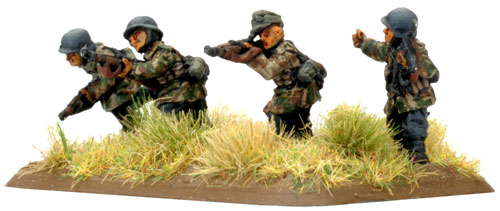
You can field a Luftaffe Jägerkompanie using the Beach Defence Grenadier Company from page 18 of D-Day: German and the 16th Luftwaffe Field Division Air Force Soldiers command card.
|
 |
Last Updated On Wednesday, October 16, 2019 by Wayne at Battlefront
|
|
|