|
|
|
|
Sorry, no articles were found.
|
|
|
|
 |
|
|
 |
 |
|
Before a game, you need to pick the Formations and Units that will make up your force. There are two ways to do this:
- Build to a points limit, or
- Build for a specific scenario.
Points Limit
If you are playing a pick-up game with a friend, you can agree to a points limit before the game. A force of say 50, 75, 100, 125, or even 150 points makes a great game.
As a guide a small 50-point game will be fairly quick to play, while a 100-point game will take a couple of hours. A bigger game is likely to take a whole afternoon or evening.
Once you have an agreed points limit, pick your force from a Force Diagram so that the total points value of all of your Units is no more than the agreed amount.
|
|
Scenario
You and a friend could organise a scenario game that tells the story of a specific battle. Linking your scenarios into a campaign allows you to extend the story across multiple games. In a scenario, you decide on a situation that would provide an interesting challenge for both players and select two forces that fit the scenario.
The forces used in a scenario will usually be based on a Force Diagram, but may contain variations specific to the scenario. The two forces might have the same points total, or they might not, it all depends on the scenario you are creating. If one force is much stronger than the other, the scenario will usually include some additional difficulty for the stronger force to make the game fun for both players.
Click here to see the Missions for Flames Of War and download the full PDF...
|
|

|
|
The first part of picking your force is to choose the Force Diagram you will use. You’ll find Force diagrams in Flames Of War army books. Select the book covering the nationality you want and you’re ready to go.
Picking Formations
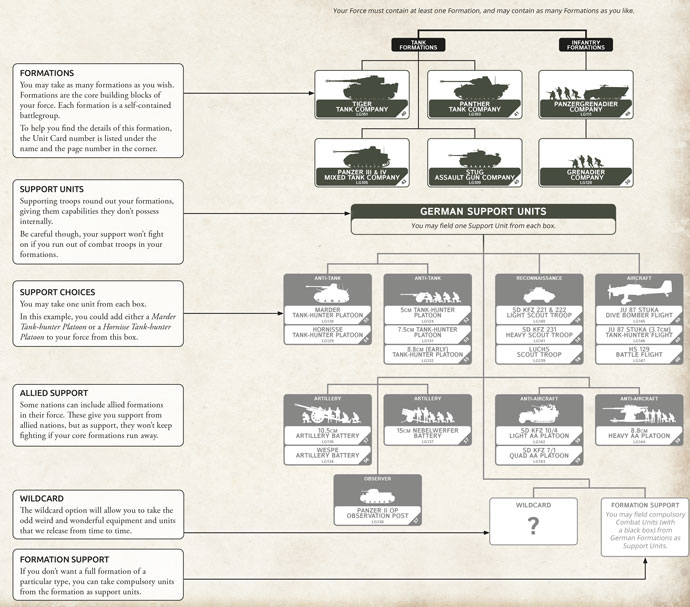
Next pick your Formations. There are six to choose from in our Force Diagram: a Tiger Tank Company, a Panther Tank Company, a Panzer III & IV Mixed Tank Company, a StuG Assault Gun Company, a Panzergrenadier Company, and a Grenadier Company. You can take one or more of these, or even several of the same Formation.
Your Force must contain at least one Formation, but you can field as many Formations as your points allow. Choosing Formations from a Force Diagram gives you access to Support Units that higher command has assigned to work with your Formation. These can be things like divisional artillery, anti-tank, or reconnaissance units, and in some forces, air support from the air force.
Sample Force
For our example force we will just take one formation of tanks, a Panzer III & Panzer IV Mixed Company
|
|
|
 |
| Formations are the core of your force and your main fighting strength. A Formation is a group of Units under a single Commander. It contains the Formation’s own troops and a slice of their parent organisation’s specialist weapons and units. The Formation Diagram is, in essence, a list of Units that you can choose from when creating that Formation. |
 |
|
Fielding a Formation
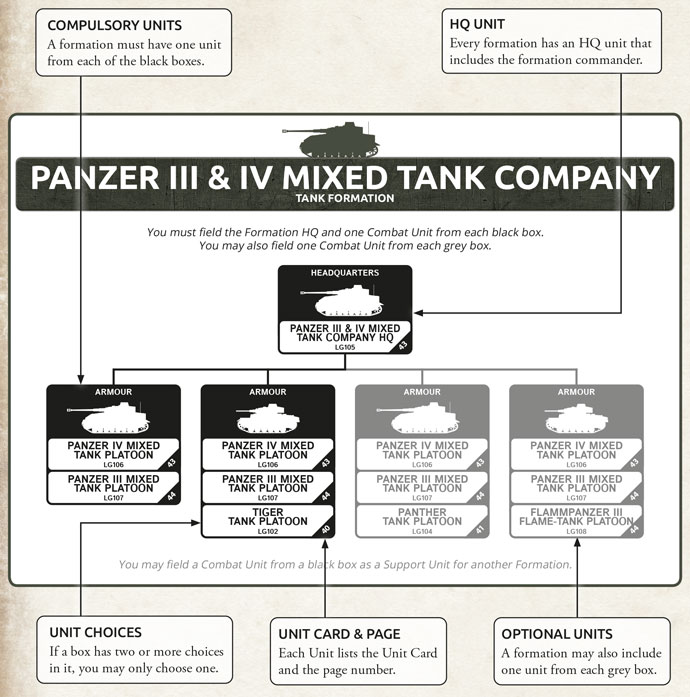
Your Formations are made up of an HQ Unit and a number of combat Units. You must field the HQ Unit and one Unit from each black box, and may field one Unit from each grey box.
The Formation diagram above shows that a Panzer III & IV
Mixed Tank Company has:
- a Panzer III & IV Mixed Tank Company HQ and
- two to four Panzer IV Mixed Tank Platoons or a Panzer III Mixed Tank Platoons
and that you may replace some of these with:
- a Tiger Tank Platoon
- a Panther Tank Platoon, or
- a Flammpanzer III Flame- Tank Platoon.
|
| Units are the fundamental building blocks of your force. The teams of a unit fight together as a closely-coordinated group, supporting each other as they take the fight to the enemy. |
Support
There are four ways to get support for our force: Support Units, Formation Support, Allied Support, and Wildcards. |
Support Units
Support Units are things like reconnaissance and artillery that are held by the divisional commander and allocated out as needed. You can field one Unit from each box in the support area. |
| One point to note is that while Support Units are very powerful additions to your force, they don’t count towards Formation Last Stand tests. So if you run out of combat troops in your Formations, your Support Units will quit the field and the game is over. |
Formation Support
Formation Support represents a higher commander reinforcing your Formations with additional Units from other Formations. You can take any compulsory Units (other than the HQ Unit) from other Formations in your Force. You may only have one of each type of Unit as Formation Support, and only if you don’t already have it in one of your Formations. This is an easy way to get some support from a combat unit without needing to add an entire additional Formation to your force. |
Allied Support
Often allied forces fought side by side, and sometimes assisted each other. Good examples of this are the way British and American units cooperated in the Battle of Normandy. You can take a compulsory Unit (other than the HQ Unit) from an Allied Formation as a Support Unit, or even an entire Allied Formation as part of your force (or both if you want).
An Allied Unit or Formation obeys all the rules for its own nationality. It can only benefit from the Command Leadership of its own Formation Commander, and its Formation Commander cannot give Command Leadership to other Support Units.
|
Wildcards
The Wildcard Support option allows you to add interesting oddities to your force. These could include odd or experimental equipment and elite specialists like the partisans or SAS (Special Air Service) raiders.
|
|
This formation was made using Force Of War. Forces provides players with a simple and intuitive way to build army lists for Flames Of War.
Forces takes the heavy lifting out building an army. With a few clicks you can build an army, then you can print or save it for submitting to tournament organisers or giving to your opponents. It even provides the card reference information to help you track down the appropriate Unit Cards from your collection.
|
|
Click here to go to Flames Of War Forces...
|
Last Updated On Monday, July 4, 2022
|
|
|