|
|
|
|
Products mentioned in this Article
--None--
|
|
|
|
|
|
|
|
|
 |
|
|
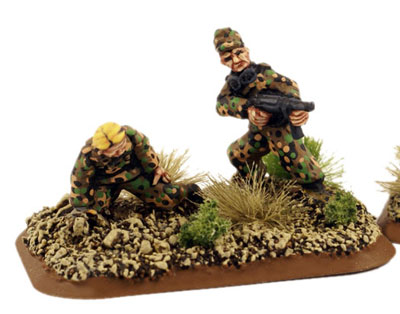 |
Painting pea dot Camouflage on your Waffen SS
By Dave Robotham
The Origins of “Pea Dot”
The SS were developing their own unique camouflage patterns and uniforms from as early as 1935 and by the time the war started they were outfitted with reversible smocks, helmet covers and zeltbahn (the triangular canvas sheet that was used as a shelter and could also be used as a poncho). However, very quickly a rather large range of other field-made and official items was issued to the troops. |
|
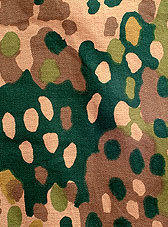
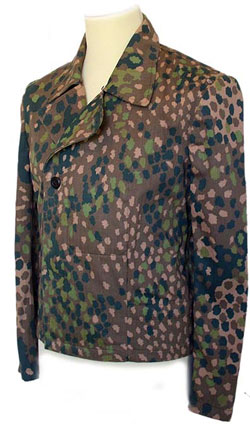
Up until 1944 the different variations of Oak Leaf and Plane Tree patterns made up the majority of the official SS camouflage patterns. It wasn’t until March 1944 that the SS-Erbsenmuster pattern (also known by a few different names including Pea Dot, Dot 44 and Pea Pattern) was introduced.
The pea dot pattern starts as a base of chocolate brown over which black, light green, light tan and olive patches are placed and then over the top of them the same colours are scattered as a mass of flecks or spots.
This new SS-Erbsenmuster pattern was officially used on camouflage smocks as well as a trouser/shirt drill uniform and winter uniforms. Lastly a two piece uniform for Panzer crews was issued although unofficial field-made garments like helmet covers were produced by the soldiers on campaign.
|
 |
 |
Painting Camouflage Principles
When tackling any form of camouflage on wargames models of any scale you have to realise that you will never be able to get a spot-on copy of the pattern. Most of the time your intended design will need to be abstracted to allow ease of painting and more importantly to make it recognisable and not just a swirl of unidentifiable colours.
On 15mm figures you do not want to be messing about highlighting the camouflage as you are essentially just adding more colours to the pattern and it becomes a mess.
The key to successfully transferring a camouflage pattern to your models is being able to recognise the order in which colours need to be applied. This is especially true with patterns as complex as Pea Dot.
Transferring colours direct from pictures of the patterns onto your figures can also often lead to different colours in the pattern being too close in tone and so the pattern becomes muddy and hard to see. These colours look fine on real clothing and garments but as soon as they are shrunk to 15mm they just don’t work. Colours need to be made brighter and the contrast needs to be enhanced. Instead of a chocolate background for instance try a lighter tan colour. Instead of a dark green try using black.
By taking the pattern to these extremes of contrast you make it easier to see colours and identify patterns. It’s my opinion that for an artistic and visual hobby like miniature painting and wargaming, having models that look right and are great to look at is far more important that having properly camouflaged models.
|
Painting “Pea Dot” Camouflage
To start with I looked at how the pattern was built up and how the colours were mixed together. The first thing I noticed was that of the 5 colours the olive green just wouldn’t show up on a 15mm model and would only muddy up the pattern. Along those lines I also decided to remove the spots and flecks of chocolate Brown. I was already planning on starting with a brown base colour and additional dots of this colour would not stand out very well against the three other colours (light green, black and light tan). |
Step 1:
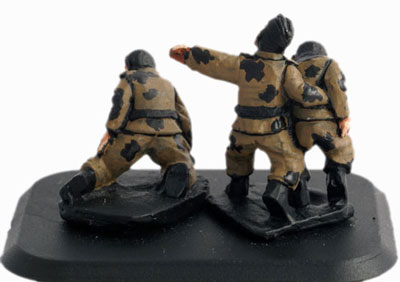
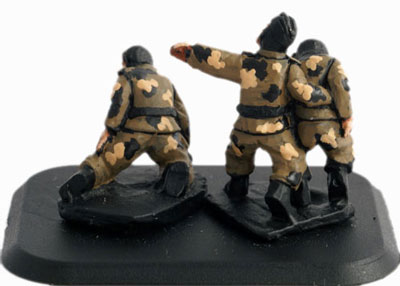
Apply a coat of Vallejo English Uniform (921) to the areas you want to be pea dot. After that you are ready to start blocking in the larger patches of colour. Start with black (any acrylic black will do but Vallejo Black (950) is a good start). The trick to keeping the patches looking random is to make sure each patch has no straight sides or long curves. I painted the patches by dotting paint onto the surface, this helps build up the erratic look to the patches. |
 |
 |
Step 2:
Next paint patches of USA Tan-Earth (874) in the same manner as with the black patches. Try to make sure most of these light brown patches are butting up against a black patch. If USA Tan-Earth seems a touch too dark for your liking mix in some white to lighten the colour. |
Step 3:
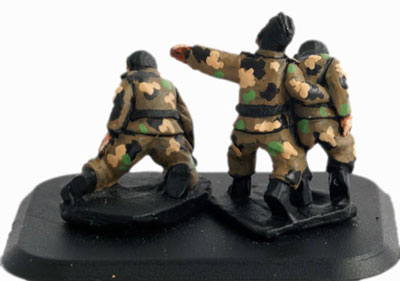
The next step is to paint patches of German Cam. Bright Green (833) onto the uniform taking care to try and keep them away from any other patches of black and light brown. |
 |
 |
Step 4:
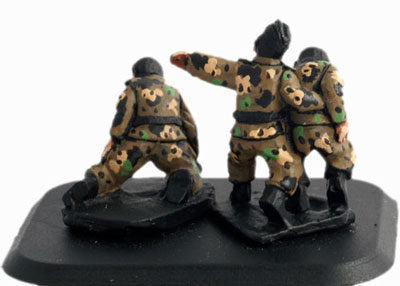
Now comes the dots… Start with the black dots. Apply the dots all over the uniform excluding the black patches (obviously). Be sure not to make the pattern of dots too dense as you have two more layers of dots to paint on.
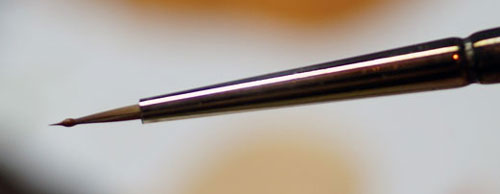
To ease painting the dots pay attention to how the paint is sitting on the bristles of your brush after you have loaded it, especially if you brush has a very good point to it.
|
| After dipping the bristles into your paint the brush will be holding the paint in a bubble about one or two millimetres from the point of the brush like this (right): |
 |
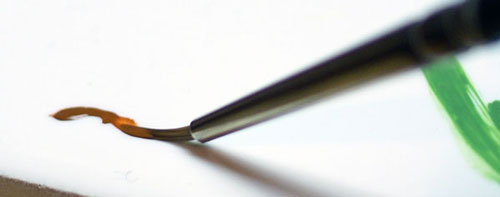 |
If you try to paint neatly with the paint like this the bubble will burst and the paint will flow from the brush in an uncontrolled way ruining any neatness you may have been aiming for.
The trick is to roll the bristles across your pallet to even the paint out along the bristles and ease the flow of paint allowing you more control (left). |
Step 5:
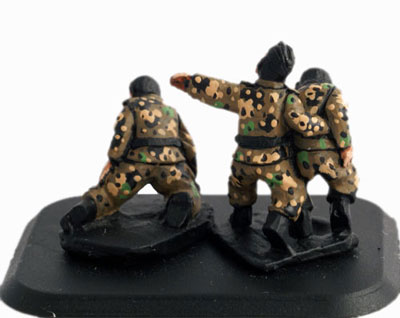
Using USA Tan-Earth now paint a layer of dots over the uniform avoiding the patches of the same colour. |
 |
 |
Step 6:
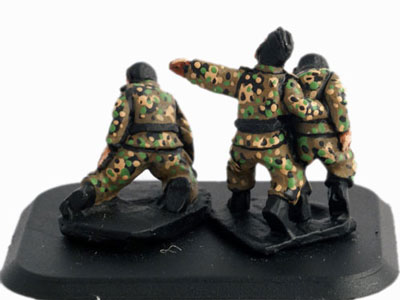
To finish off the pattern now paint a layer of dots using German Cam. Bright Green . When painting these three layers of dots don’t worry too much if you end up layering some dots over others; it won't matter overall in the grand scheme. After finishing the camouflage pattern you might want to work some black paint into the recesses defining things like arms held against bodies and neatening up the belt pouches and any point where the camouflage stops, like cuffs and collars. |
Although “Pea Dot” may initially seem like a very complicated pattern to paint hopefully this guide has show how easy it is to produce something that looks great but is still simple and quick to paint.
May your brushes always be pointy,
~ Dave Robotham.
For more on SS camouflage see Simon Hooker’s article on Plane Tree and Oak Leaf... |
Last Updated On Thursday, April 2, 2020 by Wayne at Battlefront
|
|
|